

Emotional Blunting Assessment Tool
Is it the Medication or the Depression?
This interactive tool helps you identify patterns of emotional flatness. Use these results to facilitate a more specific conversation with your doctor.
The Reality of Feeling Nothing
If you feel like you've lost your emotional edge, you aren't alone. Research from the University of Cambridge and University of Copenhagen suggests that between 40% and 60% of people taking SSRIs (Selective Serotonin Reuptake Inhibitors) or SNRIs (Serotonin-Noradrenaline Reuptake Inhibitors) experience some level of this numbness. While some clinics claim this is rare, the actual patient experience tells a different story. People often describe it as "emotional numbness" or "detachment." You might find that your reactions to significant life events are muted, or you simply lack the motivation to engage with things you used to love.
It is helpful to distinguish between behavioral apathy-where you just don't feel like doing things-and actual emotional blunting, where the feeling itself is missing. Some experts call this "SSRI-induced indifference." It doesn't just affect the bad feelings; it hits the good ones too. This restricted emotional range means you're essentially stuck in a middle zone where nothing feels particularly intense.
Why Does This Happen? The Science of the "Flatness"
For a long time, doctors weren't entirely sure why this happened. However, a 2022 study from the University of Cambridge provided a breakthrough explanation. It turns out these medications affect reinforcement learning, which is the behavioral process our brains use to learn from the environment based on rewards and punishments. When this process is dampened, the "reward" of a positive emotion doesn't hit the same way.
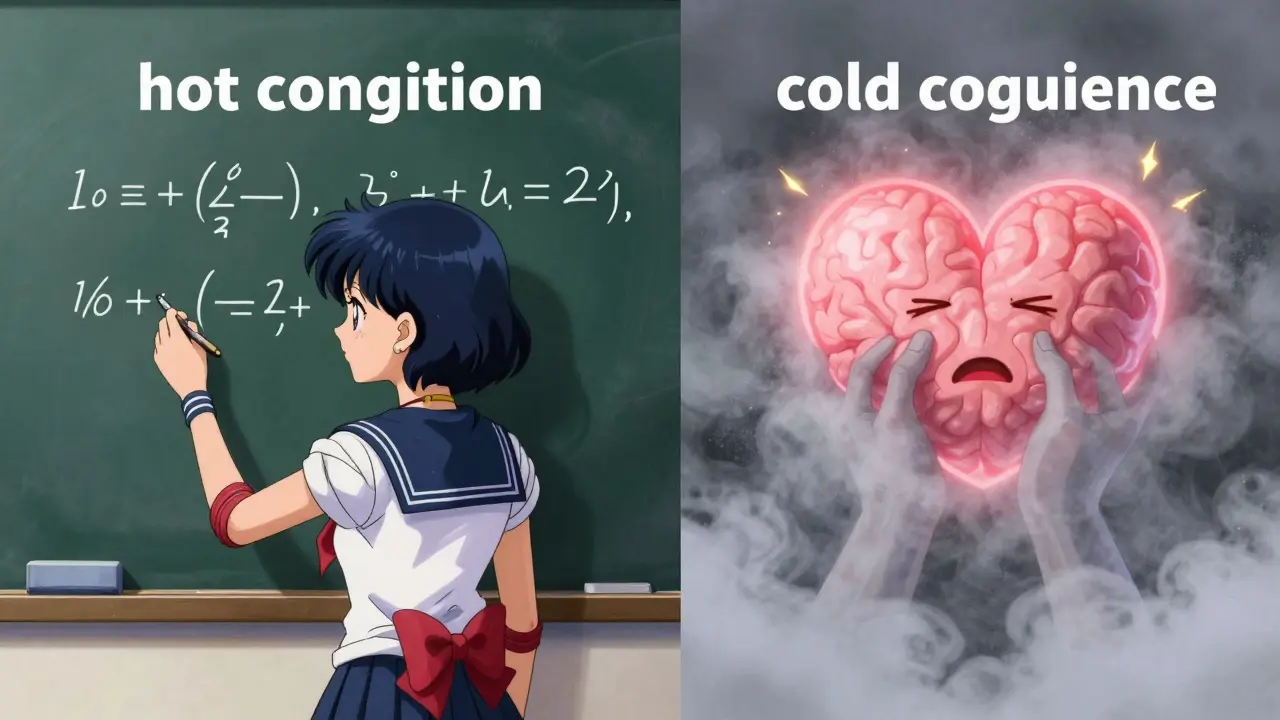
In technical terms, SSRIs impact what researchers call "hot cognition." While "cold cognition" (your ability to remember a grocery list or solve a math problem) remains intact, hot cognition-which handles emotional processing, moral judgment, and decision-making-gets suppressed. This is why you can still function at work perfectly well, but you might struggle to feel a deep connection with your partner during an argument or a heartfelt moment.
Which Medications Are Most Likely to Cause It?
Most people associate this with common medications like Escitalopram, Sertraline, Fluoxetine, and Paroxetine. Interestingly, the data suggests there isn't one "worst" SSRI; the risk is fairly consistent across the class. What does matter, however, is the dose. Generally, higher doses of these medications correlate with a higher risk of feeling emotionally numb.
| Medication Class | Estimated Risk/Prevalence | Primary Effect on Emotion |
|---|---|---|
| SSRIs / SNRIs | 40% - 60% | Significant reduction in emotional range (Blunting) |
| Bupropion | ~33% | Lower risk; often used to counteract blunting |
| Vortioxetine | Moderate/Lower | Potential for improved cognitive/emotional profile |
| Mirtazapine | Low/Moderate | Different mechanism (5-HT2C blockade) |
The Hidden Cost: Relationships and Creativity
The impact of emotional blunting goes beyond just a personal feeling of boredom. It can seriously strain relationships. When you can't express love, excitement, or even healthy anger, your partner may feel you've become cold or indifferent. There are heartbreaking accounts of marriages failing because one partner simply "couldn't feel" their love for the other anymore, even though they intellectually knew they still did.
For those in creative fields-writers, artists, musicians-this can be devastating. Creativity often feeds on emotional intensity. When that intensity is gone, the inspiration often goes with it. In these cases, the medication that saves you from a deep depression may inadvertently stifle the very thing that makes you feel alive.
How to Solve Emotional Blunting
If you're experiencing this, the first and most important rule is: do not stop your medication abruptly. Doing so can lead to antidepressant discontinuation syndrome, which can cause severe physical and psychological withdrawal. Always work with a psychiatrist to make changes.
Based on current clinical evidence, there are three primary strategies to regain your emotional range:
- Dose Reduction: Often, a modest decrease in dosage (25% to 50%) can lift the emotional fog without bringing back the full weight of depression. About 68% of patients see improvement with this approach.
- Adding Bupropion: Because Bupropion works on dopamine and norepinephrine rather than just serotonin, adding it as an augmentation therapy can "wake up" the reward system. This has shown a success rate of around 63% in helping patients reduce their SSRI dose while maintaining stability.
- Switching Medications: If dose reduction doesn't work, switching to a non-SSRI option is often the next step. Bupropion is frequently the preferred choice here, with a reported 72% improvement rate in emotional symptoms.

Is It the Drug or the Depression?
There is a bit of a debate in the medical community. Some doctors argue that emotional numbness is actually a "residual symptom" of the depression itself. In other words, the depression never fully left; it just shifted from "sadness" to "emptiness." This makes diagnosis tricky.
A good way to tell the difference is to look at the timing. If the numbness started shortly after you began the medication or after a dose increase, it's more likely a drug effect. If the numbness was there even before the medication, it might be part of the depressive disorder. Either way, it's a symptom that deserves attention and a tailored treatment plan.
Can I just push through the numbness until it goes away?
Unlike some side effects (like nausea or headaches) that disappear after a few weeks, emotional blunting tends to persist as long as you are on the medication. It is generally not something you "outgrow" without a change in dosage or medication type.
Will switching to a different SSRI help?
Generally, no. Because emotional blunting is linked to the way the entire SSRI class modulates serotonin and affects reinforcement learning, switching from one SSRI (like Sertraline) to another (like Fluoxetine) rarely solves the problem.
Is it safe to add Bupropion to my current SSRI?
For many, this is a standard clinical strategy, but it must be done under strict medical supervision. Adding a second medication can change how your body processes the first and may increase the risk of certain side effects, such as anxiety or insomnia.
How long does it take to feel emotions again after a dose change?
It isn't an overnight switch. Most patients report that it takes about 4 to 6 weeks after a dose reduction or medication switch to notice a significant return of their emotional range.
Does this mean the medication isn't working?
Not necessarily. In fact, for some in the depths of an acute crisis, the "numbness" is exactly what they need to function and survive. The problem arises when the treatment for the crisis becomes a barrier to living a full, emotional life during recovery.
Next Steps for Finding Your Balance
If you're feeling the effects of emotional blunting, the best thing you can do is keep a daily mood log. Track not just your level of depression, but your "emotional peaks." Did you feel any joy today? Did anything make you angry? This data is incredibly valuable for your psychiatrist.
When you go to your next appointment, be specific. Instead of saying "I feel weird," say "I can't feel joy when I'm with my children" or "I feel detached from my partner." This helps your provider understand that this isn't just a lingering symptom of depression, but a specific side effect of the medication. Whether you choose a dose adjustment or a switch to a different class of antidepressant, the goal is to find the "sweet spot" where you are stable but still human.

Doug DeMarco
April 10, 2026 AT 21:20Man, I've been through this exact thing with Zoloft! It's like living in a bubble where nothing can hurt you but nothing can touch you either. Just wanted to say you're not crazy for feeling this way! :) Keep tracking those moods, it really helps the docs understand what's actually happening in your head!
Stay strong everyone!
Trey Kauffman
April 11, 2026 AT 23:23Ah yes, the classic 'trade-off' where we exchange the agony of existence for the thrill of becoming a human beige wall. Truly a peak pharmaceutical achievement. We've basically reached a state of nirvana, if nirvana was just forgetting why you liked your favorite hobby. 🙄
Danny Wilks
April 13, 2026 AT 15:12It is quite fascinating to consider how these biochemical interventions create a sort of emotional homeostasis that, while ostensibly protective against the depths of despair, simultaneously erodes the nuanced peaks of human affection and creative inspiration. I have spent a considerable amount of time observing how this shift in internal landscape affects one's social interactions, often resulting in a subtle but perceptible distance that leaves both the individual and their loved ones feeling vaguely untethered from the organic rhythms of connection.
Emily Wheeler
April 14, 2026 AT 05:49I really appreciate the emphasis on the collaborative approach with a psychiatrist here because it feels like such a journey to find that equilibrium where we aren't just surviving the day but actually engaging with the beauty of the world around us. There's something so profound about the idea that our reward systems are just temporarily dampened and that we can actually work toward waking them up again through these specific clinical strategies, and it gives me so much hope for anyone currently feeling trapped in that gray filter to know that a more vibrant existence is possible if we just have the patience to navigate the titration process carefully and mindfully.
Ben hogan
April 15, 2026 AT 01:52Imagine thinking a basic list of meds is a 'solution' to the complex void of the human condition. This is such a reductive take on neuropsychology. It's almost cute how people think a simple dose reduction is the magic key to unlocking their soul again when they're clearly just experiencing the banal reality of chemical dependency. Honestly, most people are too lazy to actually do the therapeutic work and just want a pill to fix their 'numbness' while they continue to live boring lives. 🙄
Peter Meyerssen
April 15, 2026 AT 13:00The whole thing is just a failure of the synaptic plasticity framework in most patients. Like, we're talking about a complete dysfunction in the dopaminergic pathways during the reinforcement learning phase. It's basic neuro-pharmacology. Most people just don't get the jargon and think it's 'magic' or 'sadness.' 💅
Rakesh Tiwari
April 17, 2026 AT 05:17Oh, look at us, optimizing our 'emotional peaks' via a pharmacy. How absolutely modern and enlightened. I'm sure the pharmaceutical companies are just doing this for the goodness of humanity and not for the sweet, sweet profit of keeping us in a perpetual state of mild indifference. Truly a moral triumph of our age.
Camille Sebello
April 17, 2026 AT 16:15I feel this!! What dose are you on?? I need to know if you're on Lexapro or Prozac!!
Simon Stockdale
April 18, 2026 AT 19:55my doctor tried to tell me the same thing about 'residual symptoms' but man i know when i'm just a zombie cuz i used to be the life of the party in my hometown and now i just stare at the wall like a total loser and it's totaly a scam how they dont tell you this stuff before you start the pills because i woulda never signed up to feel like a piece of cardboard for two years straight while my life just passed me by like a train i missed!
Kelly DeVries
April 19, 2026 AT 12:40honestly some of you are just dramatic about the numbness like maybe you just dont have a personality anymore and it has nothing to do with the meds lol but seriously it is kind of a vibe to just not care about everything for a while
Ryan Hogg
April 20, 2026 AT 21:11I've been feeling this for years and it's honestly the worst part of my existence. I can't even cry when my life is falling apart and it just makes me feel more alone in the world. I tried talking to my therapist but they just don't get it, they just tell me to 'be patient' while I'm literally disappearing from the inside out. Every day is just a repeat of the last and I'm just waiting for something to actually make me feel a spark again but it never happens and it's just exhausting to pretend I'm okay when I'm actually just a hollow shell of a person.
Lynn Bowen
April 21, 2026 AT 07:18It is interesting to see how different cultures perceive this state of being. In some places, this kind of detachment is almost viewed as a meditative state, whereas in the West, we see it as a loss of self. It really highlights how much our environment shapes our interpretation of our own mental health.
Suchita Jain
April 21, 2026 AT 20:52It is highly imperative that one maintains a strict adherence to the guidance of a licensed medical practitioner. One must not allow personal anecdotal evidence to supersede the professional clinical protocol established for their specific pathology.
kalpana Nepal
April 23, 2026 AT 11:20Life is pain and pills just hide the pain. We should focus on the strength of our heritage and the spirit of our land to heal our minds instead of trusting these western chemicals that make us like robots. Simple truth.