

Every year, Americans save billions of dollars by choosing generic drugs instead of brand-name ones. But with so many pills on the shelf, how do you know you’re getting the real thing? Not all generics are created equal - and some aren’t generics at all. They’re dangerous fakes. You don’t need to be a pharmacist to spot the difference. Here’s how to make sure the medication you walk out with is safe, effective, and legally approved.
What Makes a Generic Drug Legitimate?
A legitimate generic drug has the same active ingredient, strength, dosage form, and route of administration as the brand-name version. It works the same way in your body. The FDA requires it to be bioequivalent - meaning it delivers the same amount of medicine into your bloodstream at the same rate as the brand. Studies show that 98.7% of FDA-approved generics meet this standard, with almost no difference in how they perform. The key difference? The inactive ingredients. These are the fillers, dyes, and binders that give the pill its shape and color. Because brand-name companies hold patents on those details, generic manufacturers must change them. That’s why your generic version of Lipitor might be blue instead of purple, or oval instead of capsule-shaped. That’s normal. It doesn’t mean it’s fake. Legitimate generics are made in FDA-inspected facilities, tested for purity, and tracked from factory to pharmacy. They come with full labeling: drug name, strength, lot number, expiration date, and the manufacturer’s name. If any of that’s missing, walk away.What to Look for on the Bottle and Pill
When you get your prescription, check these five things before leaving the pharmacy:- Label accuracy: The drug name and strength must match your prescription exactly. Misspellings like "Amlodipine" written as "Amlodipin" are a red flag.
- Manufacturer name: Legitimate generics list the maker - Teva, Sandoz, Mylan, or Apotex. If it says "Unknown Manufacturer" or nothing at all, it’s not legal.
- Lot number and expiration date: Every bottle must have both. You can enter the lot number into the FDA’s recall database to see if it’s been flagged.
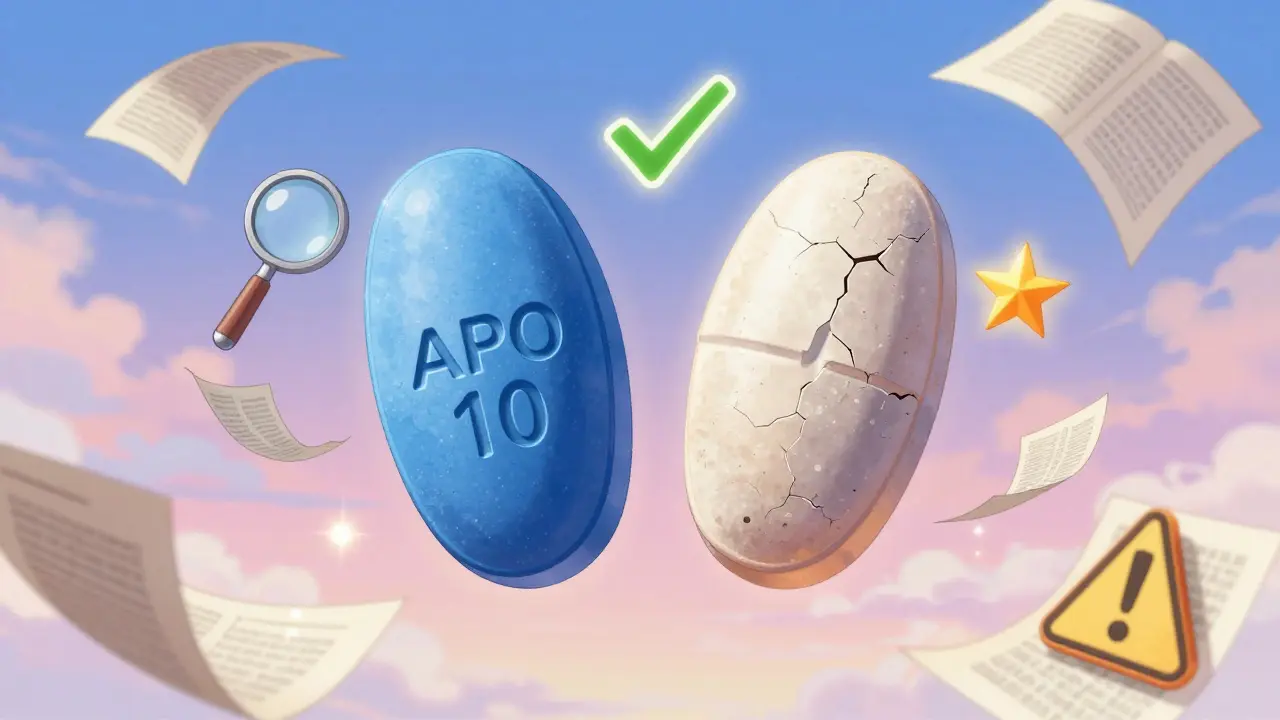
- Pill imprint: Most tablets have letters or numbers stamped on them. This identifies the drug and manufacturer. If the imprint is blurry, uneven, or missing, don’t take it.
- Physical condition: The pill should be solid, uniform in color, and free of cracks, chips, or powdery residue. If it’s crumbling, sticky, or smells weird, it’s compromised.
Counterfeit pills often look off. They might have inconsistent coloring - one pill dark red, the next light pink. Or the imprint might be too shallow, too deep, or completely wrong. Fake pills sometimes have a strange taste - metallic, bitter, or chemical. If you’ve taken this drug before and the taste changed suddenly, that’s a warning.
Where You Buy Matters More Than You Think
Buying from a licensed U.S. pharmacy is the single best way to avoid counterfeit drugs. That means:- Walking into a local pharmacy with a real storefront and licensed pharmacists on staff
- Using an online pharmacy with the .pharmacy domain (like www.drugstore.pharmacy)
- Avoiding websites that sell pills without a prescription
The National Association of Boards of Pharmacy (NABP) found that 96% of online pharmacies selling drugs without prescriptions are illegal. Many of them are based overseas and ship unregulated products directly to your door. These sites often use fake logos, copied branding, and misleading claims like "FDA-approved" or "No prescription needed."
Even if the website looks professional, if it doesn’t require a prescription or doesn’t list a physical address and phone number, it’s not safe. The FDA has shut down hundreds of these sites - but new ones pop up every week.
Legitimate pharmacies, on the other hand, use the Drug Supply Chain Security Act (DSCSA) system. Since late 2023, every prescription drug in the U.S. must have a unique serial number. Pharmacies scan these numbers to verify authenticity before dispensing. If your pharmacist is scanning your bottle, they’re doing their job.
Use the FDA’s Orange Book to Verify Your Drug
You don’t need to be an expert to check if your generic is approved. The FDA’s Orange Book lists every approved generic drug and its brand-name equivalent. Go to the FDA website and search by drug name. You’ll see:- The brand name
- The generic manufacturer
- The approval date
- The therapeutic equivalence rating (usually "AB" for fully equivalent)
If your generic isn’t listed, it’s not FDA-approved. Some manufacturers sell unapproved versions under the radar. These aren’t illegal to produce, but they’re not allowed to be sold in the U.S. market. If your pharmacy is giving you one, they’re breaking the law.
Don’t confuse this with foreign generics. Drugs from Canada or India might be cheaper, but unless they’re imported through legal channels and approved by the FDA, they’re not guaranteed safe. The FDA doesn’t inspect foreign factories the same way it does U.S. ones.
Recognizing Red Flags in Packaging and Behavior
Counterfeiters are getting smarter. Some now use real bottles from legitimate drugs, refill them with fake pills, and reseal them. Here’s how to catch them:- Crooked or wrinkled labels: 78% of counterfeit drugs reported to the FDA had misaligned or poorly printed labels.
- Foreign language on the label: If you’re in the U.S. and your pill bottle has instructions in Spanish, Chinese, or Russian - and you didn’t ask for it - that’s a sign of illegal import.
- Generic baggies instead of bottles: Legitimate pharmacies never dispense prescription drugs in plastic bags unless it’s an emergency. If you’re handed a ziplock with pills inside, refuse it.
- Price that seems too good to be true: A 30-day supply of metformin should cost $4-$10 at a major pharmacy. If it’s $1, it’s likely fake. Legitimate generics are cheap, but not that cheap.
- Pharmacist hesitation: If your pharmacist seems unsure about the generic, or can’t tell you the manufacturer, ask for another one. Reputable pharmacies keep manufacturer databases on hand.
What to Do If Something Feels Off
If you spot something suspicious - a strange pill, a missing label, a weird taste - don’t take it. Don’t throw it away. Don’t just complain. Report it.Use the FDA’s MedWatch program. You can file a report online in under five minutes. Include:
- Drug name and strength
- Lot number and expiration date
- Where you bought it
- Photos of the packaging and pill
Every report helps the FDA track counterfeit trends. In 2022, over 1,200 reports came in - 41% involved heart medications, 29% involved ED drugs. These are the most commonly faked because they’re expensive and in high demand.
If you’re worried about your health after taking a suspicious drug, call your doctor. Don’t wait for symptoms. Some counterfeits contain toxic substances like lead, rat poison, or fentanyl. Others have no active ingredient at all - meaning your condition isn’t being treated.
Technology Is Making Verification Easier
New tools are helping consumers verify drugs faster. Since 2022, major generic makers like Teva and Viatris have put 2D barcodes on every pill bottle. You can scan them with free apps like MediSafe or the FDA’s new Drug Verification app. The app checks the serial number against the national database and tells you in seconds if it’s legitimate.By 2025, AI-powered visual scanners will be available in pharmacies. These tools analyze the pill’s shape, color, and imprint using machine learning - with 99.2% accuracy. You won’t need to do anything. The pharmacist will just scan it.
For now, though, the best tool you have is your eyes and your right to ask questions. You’re not being difficult. You’re being smart.
Bottom Line: You’re Not Alone - And You’re Not Overreacting
Millions of Americans take generic drugs every day without issue. They’re safe, effective, and save the country over $370 billion a year. But that doesn’t mean you should blindly trust every pill.Take 30 seconds to check the label. Ask your pharmacist where it’s made. Compare the pill to pictures on the FDA’s website. If something doesn’t feel right, it probably isn’t. Don’t let fear stop you from using generics - but don’t let laziness put you at risk.
Legitimate generics are your right. Counterfeit drugs are a crime. Know the difference. Speak up. Protect yourself.
Are generic drugs really as effective as brand-name drugs?
Yes. The FDA requires generic drugs to be bioequivalent to their brand-name counterparts, meaning they deliver the same amount of active ingredient into your bloodstream at the same rate. Studies show that 98.7% of approved generics meet this standard. In most cases, you won’t notice any difference in how they work. The only differences are in inactive ingredients like color or shape - which don’t affect performance.
Why do generic pills look different from brand-name pills?
U.S. law prevents generic manufacturers from copying the exact appearance of brand-name drugs, including color, shape, and size, to avoid trademark infringement. So generics are made to look different - but they contain the same active ingredient and work the same way. A blue oval pill might replace a purple capsule, but the medicine inside is identical.
Can I trust generic drugs bought online?
Only if the online pharmacy is accredited by the National Association of Boards of Pharmacy (NABP) and has the .pharmacy domain. Over 96% of online pharmacies selling drugs without a prescription are illegal and sell counterfeit products. Avoid sites that don’t require a prescription, don’t list a physical address, or offer prices that seem too good to be true.
What should I do if I suspect my generic drug is fake?
Stop taking it immediately. Do not throw it away. Take photos of the packaging and pill, note the lot number and expiration date, and report it to the FDA through MedWatch. Then contact your pharmacist and doctor. Reporting fake drugs helps the FDA track and shut down illegal operations.
How can I verify a generic drug is FDA-approved?
Use the FDA’s Orange Book database. Search by the drug name - it will show you all approved generics, their manufacturers, and therapeutic equivalence ratings. If your drug isn’t listed, it’s not FDA-approved. You can also check the bottle for the manufacturer’s name and lot number, then verify it on the FDA’s recall site.
Are generic drugs made in other countries safe?
Generic drugs made in other countries are only safe if they’re imported legally and approved by the FDA. The FDA inspects U.S.-based manufacturing facilities regularly, but foreign factories are inspected less often. If you buy a generic drug from a foreign website or unregulated source, there’s no guarantee it meets U.S. safety standards. Always buy from U.S. pharmacies or verified online sources.

Angela Stanton
January 9, 2026 AT 07:17OMG this is so needed 😭 I just got a generic metformin that tasted like battery acid. Checked the imprint - it was blurry as hell. Ran the lot number through FDA’s database and it was flagged for recall. I swear, if you don’t verify, you’re playing Russian roulette with your pancreas. 🚨
Kiruthiga Udayakumar
January 10, 2026 AT 01:44People in India buy generics from here and think they’re safe? 🤦♀️ You think your $2 pill from a shady website is the same as one from a U.S. pharmacy? Wake up. The FDA doesn’t inspect factories in Bangladesh or China like they do in New Jersey. If you’re not buying from a licensed U.S. pharmacy, you’re not just saving money - you’re risking your life. And no, ‘it worked for my cousin’ doesn’t count as evidence.
Maggie Noe
January 10, 2026 AT 18:16It’s funny how we trust our phones more than our medicine. We scan QR codes to check if our avocado is organic, but we swallow a pill with no idea where it came from. The tech is here - the FDA’s Drug Verification app, 2D barcodes, AI scanners - but we’re still too lazy to use it. We want convenience, but we don’t want responsibility. And that’s the real crisis. Not the fakes. The apathy.
Heather Wilson
January 11, 2026 AT 12:05Let’s be clear: if your generic drug doesn’t have a manufacturer name, lot number, and expiration date, it’s not just illegal - it’s a violation of federal law. The fact that people are even asking if this is a big deal shows how broken our public health literacy is. You wouldn’t eat food without a label. Why do you swallow pills without one? This isn’t opinion. It’s regulation. And ignoring it isn’t bravery - it’s negligence.
Micheal Murdoch
January 12, 2026 AT 14:26For anyone new to generics - you’re not alone. I used to panic every time my pill looked different. Then I learned to check the Orange Book and ask my pharmacist for the manufacturer. Turns out, Teva makes 30% of all generics in the U.S. and their quality is rock solid. Don’t fear the color change. Fear the silence. If your pharmacist can’t tell you who made it, ask for someone who can. You’ve got rights. Use them.
Johanna Baxter
January 14, 2026 AT 12:05I took a fake Adderall once and nearly died. Like, full-on chest pain, shaking, hallucinating. Turns out it had fentanyl in it. I didn’t even know what that was. Now I scan every pill. I cry when I see someone buy from a sketchy site. You think you’re saving $50? You’re gambling with your brain. And I’m not overreacting - I’m alive because I did.
Patty Walters
January 16, 2026 AT 01:47ps. if the label says "Made in China" and you’re in the US - that’s not a red flag by itself. BUT if it’s got no lot number, no manufacturer, and the imprint is smudged? RUN. Also, I always take a pic of the pill before I take it. Helps if you need to report it later. Just a little habit that saved my butt once.
Phil Kemling
January 16, 2026 AT 20:31What if the system is designed to make us feel powerless? We’re told to trust the pharmacy, the FDA, the brand - but when things go wrong, we’re left alone to figure out if our pill is real. Maybe the real question isn’t how to spot a fake - but why we’re expected to do it at all. Shouldn’t safety be automatic? Or are we just the price of efficiency?