

It starts with a bite you didn’t feel. You’re hiking, gardening, or just walking through tall grass, and a tiny, poppy-seed-sized nymph tick latches onto your skin. Hours later, it’s feeding. Days later, a strange red ring appears on your leg. If you ignore it, the bacteria inside that tick-Borrelia burgdorferi is a spirochete bacterium that causes Lyme disease by invading human tissues after being transmitted via infected blacklegged ticks-can spread to your joints, heart, and nervous system. This is Lyme disease, also known as Lyme borreliosis. It is the most common vector-borne illness in the United States, affecting approximately 476,000 people annually according to CDC estimates. The difference between a quick recovery and months of debilitating pain often comes down to one thing: time.
Understanding the timeline of this infection is not just academic; it is a survival skill for anyone who spends time outdoors. The bacteria do not jump into your blood instantly. They need a window of opportunity. Knowing how wide that window is, what signs to look for during each stage, and exactly when to seek medical help can save you from long-term health complications. Let’s break down the biology, the symptoms, and the treatment protocols so you know exactly what to do if you find a tick on yourself.
How Ticks Transmit the Infection
The culprit behind Lyme disease is primarily the Blacklegged tick (Ixodes scapularis) in the eastern and central U.S., and the Western blacklegged tick (Ixodes pacificus) along the West Coast. These are not the large, easy-to-spot dog ticks you might be used to seeing. The primary transmitters are nymphs, which are roughly 2 millimeters in size-about the size of a poppy seed. Because they are so small, you likely won’t feel them bite you. Their saliva contains anesthetic properties that numb the area, allowing them to feed undisturbed for days.
Here is the critical detail that changes everything: transmission takes time. According to the Centers for Disease Control and Prevention (CDC), an infected tick must generally be attached and feeding for more than 24 hours before it can transmit the Lyme bacteria. Some research suggests this window could open as early as 15 hours depending on the specific strain of the bacteria, but the 24-hour mark remains the standard safety benchmark. During this feeding period, the bacteria move from the tick’s midgut to its salivary glands. When the tick regurgitates saliva into your skin to keep the blood flowing, the bacteria enter your body.
This biological lag gives you a powerful tool: prevention through inspection. If you shower within two hours of coming indoors, you wash off unattached ticks. If you perform a full-body tick check within two hours, you can remove attached ticks before they have had enough time to infect you. Removing a tick within 24 hours reduces your risk of infection by approximately 95%. This is why daily checks are non-negotiable in high-risk areas like the Northeast, Mid-Atlantic, and Upper Midwest.
Stage 1: Early Localized Lyme Disease
If the bacteria successfully enter your bloodstream, the first phase begins. This is called Early Localized Lyme Disease, and it typically manifests between 3 and 30 days after the bite, with an average onset of 7 to 14 days. The hallmark sign is Erythema migrans (EM) rash. This is not just any bug bite reaction. It expands slowly over days, often reaching several inches in diameter. In about 70% to 80% of cases, it forms a classic "bull’s-eye" pattern-a red outer ring with a clearing in the center. However, don’t wait for the perfect bull’s-eye; in many cases, the rash is simply a solid red blotch that feels warm to the touch.
Alongside the rash, you may experience flu-like symptoms. About 70% of patients report fatigue, while 61% suffer from headaches and 45% develop a fever. Your neck might feel stiff, and your muscles could ache. These symptoms are easily mistaken for a common cold or seasonal allergies, which leads to dangerous delays in treatment. Dr. Allen Steere, who first identified the disease in Connecticut in 1975, emphasizes that the EM rash is pathognomonic for Lyme disease. This means if you see that expanding red rash after a tick bite, you have Lyme disease. You do not need a blood test to confirm it at this stage. The immune system hasn’t produced enough antibodies yet for tests to detect anyway.
The treatment for this stage is straightforward and highly effective. A course of oral antibiotics, usually doxycycline for adults or amoxicillin for children, lasts between 10 and 21 days. Most patients start feeling better within 24 to 48 hours of starting medication. The key here is speed. Treating Stage 1 prevents the bacteria from spreading to other parts of your body.
Stage 2: Early Disseminated Lyme Disease
If you miss the first stage, the bacteria multiply and travel through your bloodstream to distant sites. This is Early Disseminated Lyme Disease, occurring weeks to months after the initial bite. At this point, the infection is no longer localized to the bite site. You might see multiple EM rashes appearing on different parts of your body as the bacteria spread.
The symptoms become more severe and systemic. Neurological issues begin to surface. Facial palsy, or Bell’s palsy, where one side of your face droops, occurs in 5% to 10% of untreated cases. You might experience severe headaches, neck stiffness, or pain and tingling in your hands and feet due to inflammation of the nerves (radiculoneuritis). Cardiac problems can also arise. Lyme carditis affects 4% to 10% of untreated patients, causing irregular heartbeats (arrhythmias) or dizziness. If you feel your heart fluttering or skip beats after a tick bite, seek emergency care immediately.
Diagnosis in this stage relies on two-tiered serological testing. First, an ELISA test screens for antibodies. If positive, a Western blot test confirms the presence of specific bacterial proteins. Sensitivity improves significantly here, rising to 87% compared to the low 29%-40% sensitivity in the early stage. Treatment shifts from simple oral pills to more aggressive therapy. Depending on the severity of neurological or cardiac involvement, doctors may prescribe 14 to 28 days of intravenous antibiotics like ceftriaxone. Oral doxycycline is still often used for mild neurological symptoms, but IV therapy ensures higher concentrations of the drug reach the affected tissues.
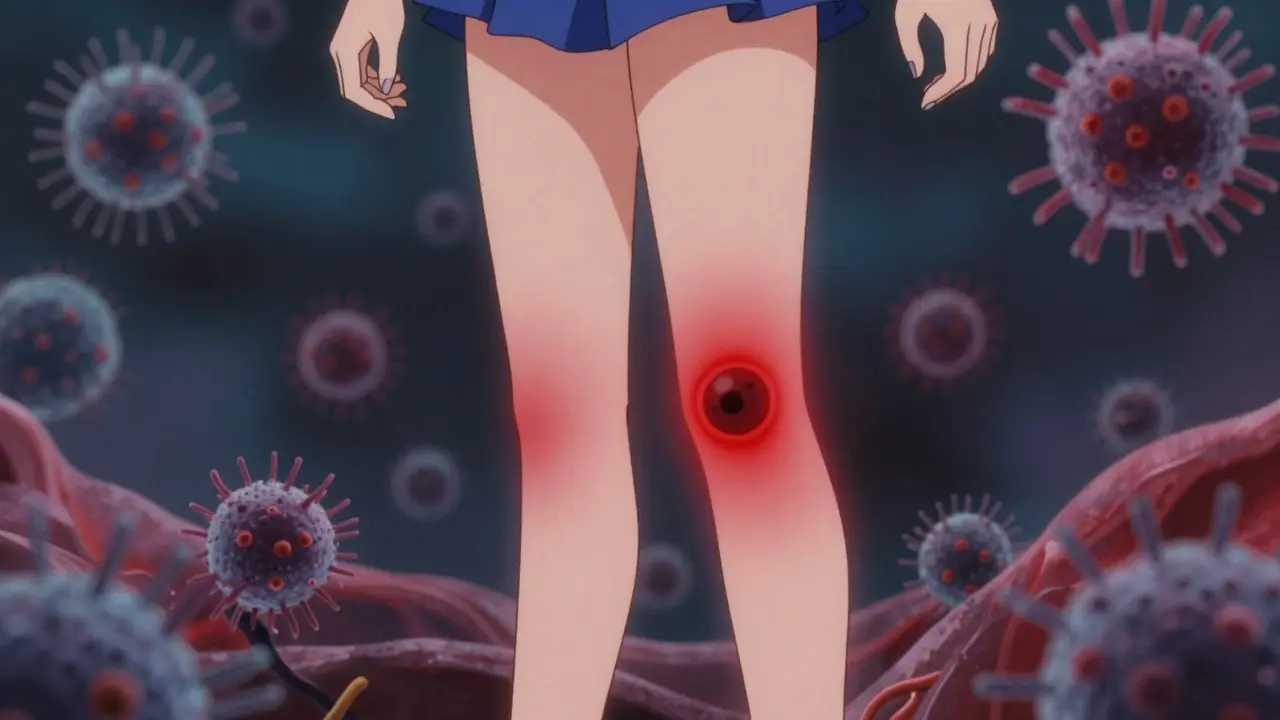
Stage 3: Late Disseminated Lyme Disease
Months or even years after the initial bite, if left untreated, the disease enters its late stage. The bacteria have caused significant damage to your joints and nervous system. The most prominent symptom is Lyme arthritis. Approximately 60% of untreated patients develop intermittent bouts of severe joint pain and swelling, particularly in large joints like the knees. The knee may swell up dramatically, becoming hot and difficult to bend.
Neurological complications deepen. Patients may experience neuropathy, chronic cognitive difficulties (often described as "brain fog"), and memory issues. Fatigue becomes profound and unrelenting. At this stage, the bacteria may no longer be actively replicating in high numbers, but the inflammatory response they triggered continues to cause tissue damage. Treatment requires prolonged courses of antibiotics, sometimes combined with anti-inflammatory medications to manage joint swelling. While symptoms can be managed, some nerve damage may be permanent if treatment was delayed for years.
The Controversy of Post-Treatment Lyme Disease Syndrome
Even with proper antibiotic treatment, about 10% to 20% of patients continue to experience symptoms for more than six months. This condition is known as Post-Treatment Lyme Disease Syndrome (PTLDS). Patients report persistent fatigue, pain, sleep disturbances, and cognitive issues. The medical community is divided on how to handle PTLDS.
The Infectious Diseases Society of America (IDSA) states there is no convincing evidence that PTLDS represents an ongoing active infection. They argue that the symptoms are likely due to residual tissue damage or an autoimmune response triggered by the initial infection. Consequently, they recommend against prolonged antibiotic therapy, citing risks of serious side effects like C. diff infections and catheter-related complications without proven benefit.
Conversely, organizations like the International Lyme and Associated Diseases Society (ILADS) argue that a subset of patients has persistent, hard-to-kill bacteria hiding in biofilms or intracellularly. They advocate for individualized, longer-duration antibiotic regimens. This debate creates confusion for patients. If you fall into this category, finding a specialist who listens to your history and monitors your progress closely is essential. Supportive therapies, such as physical therapy, cognitive behavioral therapy, and pain management, often play a larger role in recovery than additional antibiotics alone.

Prevention and Immediate Action Plan
You cannot control where ticks live, but you can control your exposure. Ticks thrive in wooded, brushy, or grassy areas. They do not jump or fly; they climb onto you from vegetation. Here is your action plan:
- Dress Smart: Wear long sleeves and pants. Tuck your pants into your socks and your shirt into your pants. Light-colored clothing makes it easier to spot dark ticks.
- Use Repellents: Apply EPA-registered repellents containing DEET, picaridin, or permethrin (for clothing only) to exposed skin and gear.
- Check Daily: Perform a full-body tick check every day during peak season (spring and summer). Pay attention to hidden spots: behind ears, in hair, under arms, in and around the belly button, behind knees, and between legs.
- Remove Properly: Use fine-tipped tweezers to grasp the tick as close to the skin’s surface as possible. Pull upward with steady, even pressure. Do not twist or jerk, as this can leave mouth-parts embedded. Clean the bite area and your hands with rubbing alcohol or soap and water.
- Consider Prophylaxis: If you are in a high-risk area and an engorged Ixodes tick has been attached for more than 36 hours, ask your doctor about a single 200mg dose of doxycycline within 72 hours of removal. This can prevent infection in many cases.
| Stage | Timeline | Key Symptoms | Diagnostic Method | Standard Treatment |
|---|---|---|---|---|
| Early Localized | 3-30 days post-bite | Erythema migrans rash, fever, fatigue, headache | Clinical diagnosis (rash) | Oral antibiotics (Doxycycline/Amoxicillin) for 10-21 days |
| Early Disseminated | Weeks to months post-bite | Multiple rashes, facial palsy, heart palpitations, nerve pain | Two-tiered serology (ELISA + Western Blot) | Oral or IV antibiotics (Ceftriaxone) for 14-28 days |
| Late Disseminated | Months to years post-bite | Severe joint swelling (knees), cognitive issues, neuropathy | Two-tiered serology + clinical evaluation | Prolonged antibiotics + anti-inflammatories |
New Developments in Diagnosis and Vaccines
The landscape of Lyme disease management is evolving. For decades, diagnosis relied heavily on imperfect antibody tests that missed early infections. In March 2023, the FDA approved the MiQLick test, a new diagnostic tool that detects Borrelia DNA in urine. With 92% sensitivity and 95% specificity in early disease, it offers hope for earlier and more accurate detection, potentially reducing the number of misdiagnosed cases.
Vaccine development is also moving forward. After the withdrawal of the only previous vaccine (LYMErix) in 2002, new candidates have emerged. Valneva, in partnership with Pfizer, is conducting Phase 3 trials for VLA15, a vaccine targeting multiple strains of Borrelia. Early Phase 2 results showed efficacy rates between 70% and 96%. Additionally, researchers at the National Institute of Allergy and Infectious Diseases (NIAID) are developing mRNA-based vaccines, similar to those used for COVID-19, which could offer broad protection against various tick-borne pathogens. While these vaccines are not yet widely available, their progress signals a shift toward proactive prevention rather than reactive treatment.
How soon after a tick bite do symptoms appear?
Symptoms of early localized Lyme disease typically appear between 3 and 30 days after the bite, with an average onset of 7 to 14 days. The first sign is often the erythema migrans rash, followed by flu-like symptoms such as fatigue, fever, and headache.
Do I need a blood test if I have the bull's-eye rash?
No. If you have a characteristic expanding erythema migrans rash and a history of potential tick exposure, doctors will diagnose Lyme disease clinically. Blood tests are often negative in the early stages because your body hasn't produced enough antibodies yet. Starting antibiotics immediately is the recommended course of action.
Can Lyme disease be cured completely?
Yes, in the vast majority of cases, Lyme disease is curable with appropriate antibiotic treatment, especially when diagnosed in the early stages. However, about 10-20% of patients may experience Post-Treatment Lyme Disease Syndrome (PTLDS), characterized by lingering fatigue and pain, which may require supportive care but is not necessarily an active infection.
What is the best way to remove a tick?
Use fine-tipped tweezers to grasp the tick as close to the skin's surface as possible. Pull upward with steady, even pressure. Do not twist or crush the tick, as this can increase the risk of infection. After removal, clean the bite area and your hands with rubbing alcohol or soap and water.
Are there new vaccines for Lyme disease?
Currently, there is no commercially available Lyme disease vaccine for humans. However, clinical trials are underway. Valneva’s VLA15 vaccine has shown high efficacy in Phase 2 trials, and mRNA-based vaccines are also in development. These may become available in the near future, offering proactive protection against the disease.
