

If you’re taking medication and enjoy a glass of pomegranate juice every morning, you’re not alone. It’s sweet, packed with antioxidants, and often marketed as a superfood. But here’s the thing: pomegranate juice might be quietly changing how your body handles your pills. And that’s not something to ignore.
Unlike grapefruit juice, which has clear, well-documented warnings on medication labels, pomegranate juice flies under the radar. You won’t see a big red sign on your blood thinner or cholesterol pill saying, "Don’t drink this." But that doesn’t mean it’s harmless. The science is messy, the real-world effects vary, and the risks are real - especially if you’re on certain medications.
How Pomegranate Juice Interacts With Your Medications
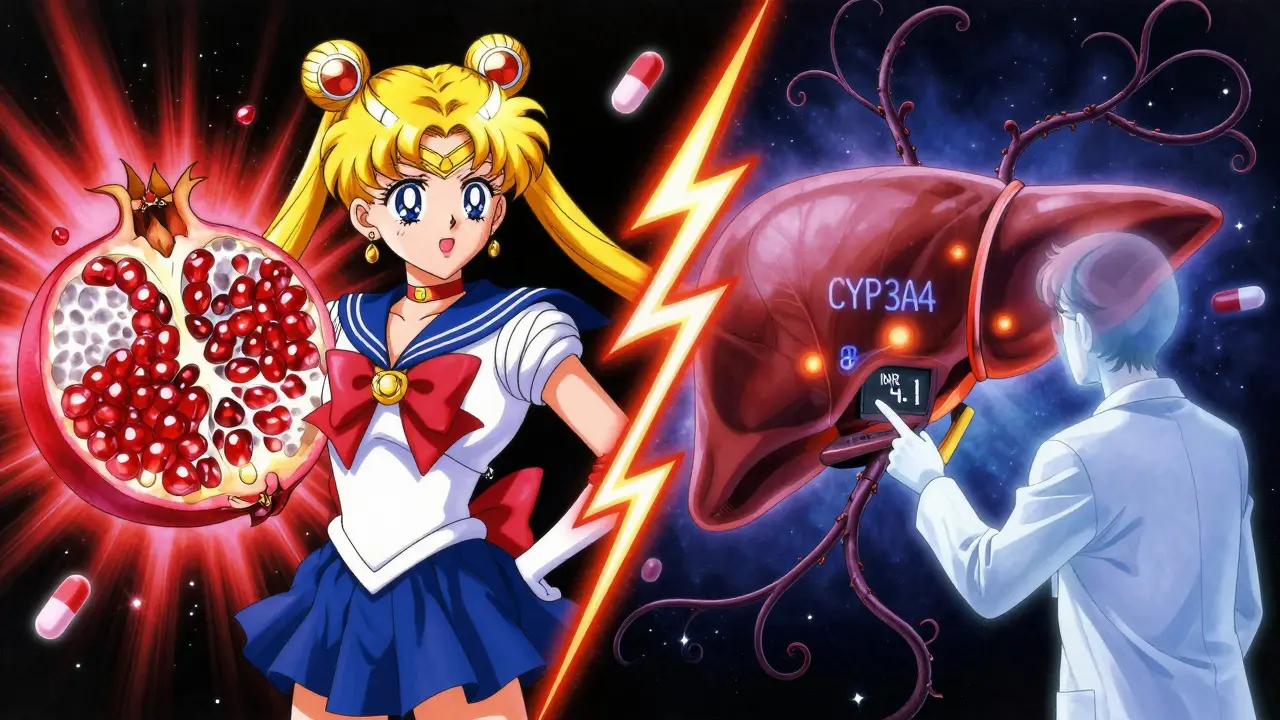
Your body uses enzymes to break down most medications. The main ones are CYP3A4 and CYP2C9 - proteins in your liver and gut that act like molecular scissors, cutting drugs into pieces so they can be cleared from your system. Pomegranate juice contains compounds called punicalagins and ellagitannins that can slow down these enzymes. Think of it like clogging a drain. If the enzymes can’t do their job, your medication builds up in your bloodstream.
This isn’t just theory. Lab studies show pomegranate juice can inhibit CYP3A4 by up to 50% and CYP2C9 by 20-40%. That’s a big deal if you’re taking a drug with a narrow therapeutic window - meaning the difference between a safe dose and a dangerous one is tiny. Warfarin, the blood thinner, is the most studied example. When CYP2C9 slows down, warfarin sticks around longer, raising your INR (a measure of blood clotting time). One case report showed INR jumping from 2.5 to 4.1 after just a few days of daily pomegranate juice. That’s a risk for dangerous bleeding.
Other medications that could be affected include:
- Statins like atorvastatin (Lipitor) - higher levels increase muscle damage risk
- Some antidepressants like sertraline and quetiapine - may cause dizziness, sedation, or heart rhythm issues
- ACE inhibitors like lisinopril - potential for excessive blood pressure drop
- Some HIV medications and painkillers like fentanyl
But here’s where it gets confusing.
The Human Evidence Doesn’t Always Match the Lab
Lab studies use concentrated extracts. Real people drink juice - diluted, inconsistent, and mixed with food. That’s why human trials often show no effect.
A 2014 study gave 12 healthy volunteers 330 mL of pomegranate juice daily for two weeks while they took midazolam, a classic CYP3A4 drug. The results? No change in drug levels. Another study on theophylline (used for asthma) found only a 7.2% increase in blood concentration - far below the 25% threshold most experts consider clinically meaningful.
Even the FDA hasn’t issued a formal warning about pomegranate juice, unlike with grapefruit, which can spike statin levels by up to 15 times. That’s because the human data just isn’t strong enough to demand labeling.
So what’s going on? The answer might be in the details: how much you drink, how often, your genetics, and what else you’re eating. One person might have a genetic variant that makes their CYP2C9 enzyme extra sensitive. Another might sip juice with breakfast and take their pill at night - enough space to avoid interaction.
Warfarin: The One Clear Red Flag
If you’re on warfarin, pomegranate juice is not something to treat lightly.
While not every study shows an effect, the real-world reports are too consistent to ignore. On Reddit’s r/bloodthinners, over a dozen users reported INR spikes after starting pomegranate juice. One user’s INR jumped from 2.4 to 4.7 in three days - enough to require a 30% dose reduction. That’s not a fluke.
Mayo Clinic and the American Heart Association both warn that even small changes in vitamin K or antioxidant intake can destabilize warfarin therapy. Pomegranate juice isn’t high in vitamin K, but its enzyme-blocking effect is enough to cause trouble.
Here’s what the experts say if you’re on warfarin:
- Avoid drinking more than 8 ounces (240 mL) per day
- Stick to the same amount every day - don’t start or stop suddenly
- Get your INR checked more often when you begin or stop drinking it
- Talk to your doctor before adding it to your routine
It’s not about banning it. It’s about control. Sudden changes are riskier than steady, moderate intake.
What About Other Medications?
For most other drugs, the risk is low - but not zero.
A 2022 survey of 1,247 patients taking chronic medications found that nearly 28% drank pomegranate juice regularly. Only 4.7% reported any possible side effects linked to interactions. That sounds reassuring. But here’s the catch: many of those side effects were never confirmed as caused by the juice. People might have felt dizzy and blamed the juice, when it was actually stress, dehydration, or a new medication.
Still, if you’re on:
- A statin (especially simvastatin or lovastatin)
- An antidepressant like quetiapine or sertraline
- A painkiller like fentanyl or oxycodone
- An HIV drug like saquinavir
It’s smart to be cautious. These drugs have narrow safety margins. Even a small increase in blood levels can lead to side effects - muscle pain, confusion, irregular heartbeat, or worse.
WebMD lists pomegranate juice as having a "moderate" interaction with 17 medications. That’s not a warning to panic - it’s a flag to pay attention.
What Should You Do?
You don’t need to give up pomegranate juice. But you do need to be smart.
Here’s your simple action plan:
- Check your meds. Look up your prescription on a reliable drug interaction checker (like Mayo Clinic’s or Micromedex).
- If you’re on warfarin or a statin, talk to your doctor or pharmacist before drinking juice regularly.
- If you already drink it, don’t change your habits suddenly. Keep the same amount every day.
- Separate your juice and meds by at least two hours. This gives your body time to process each without overlap.
- Monitor for unusual symptoms - unexplained bruising, muscle pain, dizziness, fatigue - and report them.
For most people, an occasional glass of pomegranate juice is fine. But if you’re on a medication that requires precise dosing, consistency matters more than novelty.

Why This Matters More Than You Think
People assume natural = safe. But pomegranate juice isn’t harmless just because it’s fruit. It’s a bioactive substance with real chemical effects on your body. The same way you wouldn’t take a herbal supplement without checking, you shouldn’t treat juice like a neutral beverage.
The bigger issue? Most patients don’t tell their doctors what they’re drinking. They mention vitamins. They forget about juice. They think, "It’s just fruit." But if you’re on warfarin, that glass of juice could be the reason your INR spiked. And that’s not a minor thing.
Healthcare providers can’t protect you if they don’t know what you’re consuming. That’s why honesty matters - even about what seems harmless.
Final Takeaway
Pomegranate juice isn’t the enemy. But it’s not a passive drink either. It interacts with your body’s drug-processing system. For most people, moderate, consistent intake is fine. For those on certain medications - especially warfarin - it’s a potential risk that needs attention.
Don’t panic. Don’t stop drinking it unless your doctor says so. But do ask. Do monitor. Do be consistent. That’s how you enjoy the benefits without the danger.
Can pomegranate juice interfere with blood thinners like warfarin?
Yes, pomegranate juice can interfere with warfarin by inhibiting the CYP2C9 enzyme, which breaks down the more active form of the drug. This can raise your INR, increasing bleeding risk. While not everyone experiences this, multiple case reports show INR spikes after starting regular pomegranate juice. If you take warfarin, stick to a consistent amount (no more than 8 oz daily), avoid sudden changes, and monitor your INR closely when starting or stopping.
Is pomegranate juice as dangerous as grapefruit juice?
No, not nearly. Grapefruit juice can increase blood levels of some statins by up to 15 times and is clearly labeled as dangerous with certain medications. Pomegranate juice’s effects are much weaker and inconsistent in humans. While it inhibits the same enzymes (CYP3A4 and CYP2C9), the clinical impact is far less predictable. The FDA has not issued warnings for pomegranate juice, unlike grapefruit, which has explicit labeling requirements.
What medications should I avoid with pomegranate juice?
Be cautious with medications metabolized by CYP3A4 or CYP2C9 enzymes, especially those with narrow therapeutic windows. These include warfarin, atorvastatin, simvastatin, quetiapine, sertraline, fentanyl, oxycodone, and some HIV medications like saquinavir. Always check your specific medication with a pharmacist or drug interaction tool. If you’re unsure, assume caution until confirmed safe.
How much pomegranate juice is safe to drink with medication?
For most people, up to 8 ounces (240 mL) per day is considered low-risk if consumed consistently. The key is consistency - don’t start drinking it daily if you haven’t before, and don’t stop suddenly if you do. If you’re on warfarin or another sensitive medication, talk to your doctor first. Spreading your intake throughout the day and avoiding it within two hours of taking your pill can also help reduce interaction risk.
Should I stop drinking pomegranate juice if I’m on medication?
Not necessarily. For most medications, moderate and consistent intake is safe. The bigger risk comes from sudden changes - like starting or stopping the juice without telling your doctor. If you’re on warfarin, a statin, or another high-risk drug, discuss it with your healthcare provider. They may recommend monitoring your blood levels more closely rather than eliminating the juice entirely.

Stephen Gikuma
January 1, 2026 AT 20:18They don't want you to know this but Big Pharma and the USDA are in cahoots to hide that pomegranate juice is a natural anticoagulant that's been used by ancient civilizations to destabilize Western medicine control. The FDA won't warn you because they're paid off. Your blood thinner? A corporate trap. Drink the juice, fight the system.
They'll call it 'conspiracy' but ask yourself: why does every superfood get banned after 3 years? Coincidence? I think not.
I've been drinking it since 2018. My INR went from 2.1 to 4.8 in 11 days. They tried to silence me with a 'consult your doctor' script. I told them to check the WHO's 1987 redacted report on Punicalagin suppression.
Wake up. The juice is the resistance.
They don't want you to know your body can heal itself without their patented pills.
They're scared of fruit.
Bobby Collins
January 2, 2026 AT 17:35ok but like… i drink this juice every day with my oatmeal and i take lisinopril and i swear my blood pressure’s been lower since i started. no weird bleeding or dizziness. maybe it’s just me? idk. i’m not scared of fruit lol.
also my grandma drank it in lebanon and she’s 92 and still walks her dog. so… maybe chill?
also who made this post? it feels like a drug company ad with extra steps.
Layla Anna
January 4, 2026 AT 05:54hey i just wanted to say thank you for writing this 🥹
i’ve been on warfarin for 5 years and i used to drink pomegranate juice every morning without thinking. then i had a scary INR spike last year and my pharmacist sat me down and explained all this. i didn’t even know enzymes could be blocked by fruit 😅
now i stick to 4oz every other day and i check my INR every 2 weeks. it’s not perfect but i feel way safer. i’m so glad someone’s talking about this in a real way. so many people think ‘natural’ means ‘harmless’ and that’s dangerous.
also i love that you mentioned consistency. that’s the real key. not fear. not stopping. just steady.
thank you for not scaring people. just informing them.
❤️
Heather Josey
January 5, 2026 AT 07:19This is one of the most balanced, evidence-based explanations I’ve read on this topic. Thank you for clearly distinguishing between lab data and clinical relevance. Too many health articles either sensationalize or oversimplify.
The point about consistency is critical-patients often assume that if something is 'unsafe,' they must eliminate it entirely. But in pharmacotherapy, predictability is often more important than avoidance. A steady 8 oz daily is far less risky than sporadic 16 oz binges.
I work as a clinical pharmacist and see this exact scenario weekly: patients consuming 'natural' products without disclosing them. The real failure isn’t the juice-it’s the communication gap between provider and patient.
Well done on emphasizing the need for open dialogue. That’s the real public health win here.
Liam George
January 5, 2026 AT 13:34Consider the epistemological framework: if CYP3A4 inhibition is a probabilistic phenomenon mediated by polyphenolic bioactives, then the clinical manifestation is not a binary interaction but a stochastic resonance within individual metabolic phenotypes.
The FDA’s silence isn’t negligence-it’s a reflection of the null hypothesis failing to achieve statistical significance across heterogeneous populations. But this doesn’t negate the outlier cases-those with polymorphisms in CYP2C9*2 or *3 alleles who experience supra-therapeutic INR elevation.
What we’re witnessing is not a food-drug interaction-it’s a microcosm of personalized medicine’s failure to integrate nutrigenomic data into routine care.
The real question isn’t whether pomegranate juice is dangerous-it’s why our healthcare system still operates on population averages while ignoring individual pharmacokinetic variance.
And yes, the fact that grapefruit has a black box warning while pomegranate doesn’t? That’s regulatory arbitrage disguised as science.
Wake up. The system is rigged. The enzymes don’t lie.
Ann Romine
January 7, 2026 AT 01:10I’ve been drinking pomegranate juice for 8 years and take atorvastatin. No muscle pain. No weird fatigue. I don’t drink it at the same time as my pill-always 3 hours apart. I’ve never had a problem.
But I also don’t drink it every day. Maybe twice a week. Maybe I’m lucky. Or maybe the dose is too low to matter.
I just think it’s weird how we treat fruit like it’s a drug. It’s not a pill. It’s juice. It’s not concentrated. It’s diluted with water and sugar and pulp.
Still… I get why people worry. I just wish the headlines didn’t make it sound like a poison.
Todd Nickel
January 7, 2026 AT 19:32Let’s look at the data more carefully. The 2014 midazolam study with 12 subjects had a power of less than 30% to detect a 20% change in AUC. That’s not a null result-it’s an underpowered study. Similarly, the 2022 survey of 1,247 patients relied on self-reported side effects without biochemical confirmation. That’s noise, not signal.
The real issue is publication bias: case reports of INR spikes get published. Studies showing no effect often don’t make it into journals. That skews perception.
Also, pomegranate juice varies wildly in punicalagin content-season, region, processing, brand. One bottle might have 50mg, another 200mg. No standardization means no reliable dosing.
So yes, there’s biological plausibility. Yes, there are case reports. But the population-level risk is likely low. Individual risk? Depends on your genetics, your dose, your timing, and your liver’s mood that day.
Don’t panic. Don’t ignore. Just be aware. And maybe don’t chug a bottle before your INR test.
Austin Mac-Anabraba
January 9, 2026 AT 07:06People who drink pomegranate juice while on warfarin are just gambling with their lives. You think you’re being ‘natural’? You’re being reckless. There’s no such thing as a ‘safe’ amount when your INR can spike from 2.5 to 5.0 overnight. That’s not a side effect-that’s a medical emergency.
And don’t give me that ‘I’ve been doing it for years’ crap. You’re just lucky so far. Luck isn’t a medical strategy.
If you’re too lazy to check drug interaction databases, then don’t drink it. Simple. No excuses. You’re not special. Your body isn’t different. The enzymes don’t care how ‘healthy’ you think you are.
Stop pretending fruit is medicine. It’s not. It’s sugar water with side effects.
And if you’re on statins? You’re already at risk for rhabdo. Now you’re adding a potentiator? Congratulations. You’re one glass away from the ER.
Phoebe McKenzie
January 10, 2026 AT 19:05THIS IS WHY PEOPLE DIE. YOU THINK YOU’RE HEALTHY BECAUSE YOU DRINK JUICE? YOU’RE JUST A WALKING BLOOD CLOT WAITING TO HAPPEN.
MY COUSIN WAS ON WARFARIN. DRANK POMEGRANATE JUICE EVERY MORNING. ONE DAY HE JUST… STOPPED BREATHING. NO WARNING. NO SIGNS. JUST BLED INSIDE HIS BRAIN.
THE DOCTOR SAID IT WAS THE JUICE. NO ONE TOLD HIM IT WAS DANGEROUS. NO ONE. NOT THE LABEL. NOT THE PHARMACIST. NOT EVEN THE TV.
HOW MANY MORE PEOPLE HAVE TO DIE BEFORE THEY PUT A WARNING ON THE BOTTLE?
IT’S NOT ‘MODERATE.’ IT’S NOT ‘SOMETIMES.’ IT’S NOT ‘I’M FINE.’
IT’S MURDER BY FRUIT.
AND YOU’RE ALL JUST DRINKING IT LIKE IT’S TEA.
gerard najera
January 12, 2026 AT 07:37Consistency over fear.