
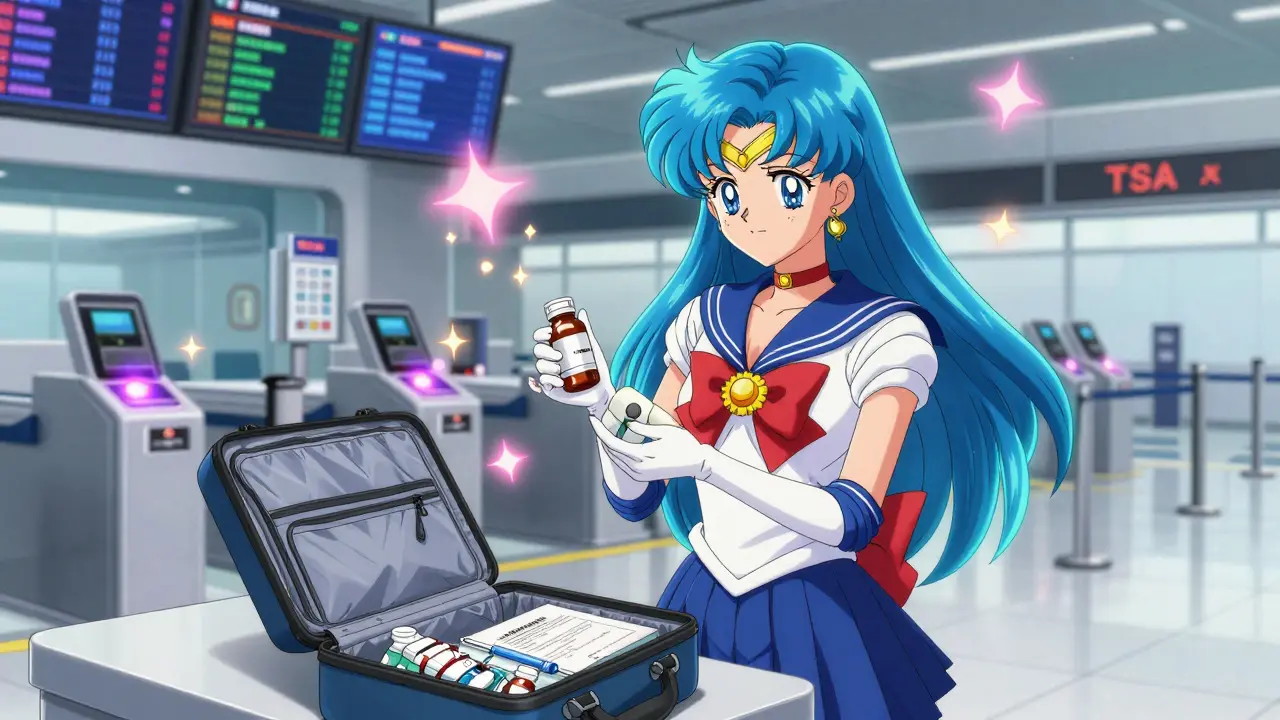
Traveling With Medications: Security, Storage, and Refills
You’ve packed your clothes, your charger, your travel pillow-but did you pack your meds the right way? If you’re flying with prescriptions, especially controlled ones like opioids, benzodiazepines, or stimulants, you’re not just carrying pills-you’re carrying legal documents that can make or break your trip. In 2025, a single misstep can mean your medication gets confiscated, you get held up for hours at security, or worse-you’re denied entry into a country.
It’s not paranoia. It’s policy. The TSA, CDC, and international health agencies have updated their rules this year, and the stakes are higher than ever. Over 14% of air travelers now carry prescription medications, and nearly 1 in 8 of them run into problems at security or customs. Most of those issues? Totally avoidable.
How TSA Handles Medications in 2025
The Transportation Security Administration doesn’t care if your pills are for anxiety, diabetes, or high blood pressure. They care about whether you can prove they’re yours-and whether they’re packed safely. Here’s what actually works in 2025:
- Keep meds in original bottles. Pharmacy-labeled containers reduce inspection time by 63%. If your pills are in a pill organizer, you’re inviting extra screening-and maybe confiscation.
- Liquids are allowed in any amount if medically necessary. Yes, even that 8-ounce insulin vial. But you must declare it at the checkpoint. Don’t hide it in your toiletries bag. Tell the officer: "I have medically necessary liquids." They’ll usually let you pass without a second glance.
- No quantity limits on pills. You can bring a 90-day supply, or a year’s worth. But if you’re carrying hundreds of pills, expect questions. A doctor’s note helps.
- Insulin pumps and glucose monitors? Always carry them on. FAA rules say lithium batteries in medical devices must stay in carry-on luggage. Checked bags can get crushed, lost, or exposed to extreme cold.
TSA’s Cares program is your friend. If you have a chronic condition, ask for a sunflower lanyard at the checkpoint. It signals to officers you need extra help. Travelers using it report 41% faster screening times. No paperwork needed-just ask.
Storage: Keep Your Meds Safe, Not Spoiled
Medications aren’t just about legality-they’re about temperature. Insulin, biologics, and some antibiotics degrade fast if left in a hot car or checked baggage. The FDA says insulin must stay between 36°F and 46°F (2°C-8°C). If it gets too hot or too cold, it loses potency. You don’t want to land in Bangkok and realize your insulin is useless.
Here’s what works:
- Use a pharmaceutical-grade cooling wallet. These aren’t regular lunch coolers. They’re designed to hold 2°C-8°C for up to 72 hours, even in 104°F heat. 73% of insulin users who use them report zero issues during tropical trips.
- Never check meds. Baggage holds can drop below freezing or spike over 120°F. Even if you think your bag is "safe," don’t risk it.
- Carry extra doses in your carry-on. Distribute your meds across two different bags. If one gets lost, you’re not left without treatment. 92% of travelers who do this avoid treatment disruption.
- Keep meds in your jacket or purse. Not your backpack. You need quick access at security. Don’t dig through your luggage when you’re on the clock.
International Rules: What’s Allowed Where
What’s legal in Seattle isn’t legal in Tokyo. And that’s where most travelers get caught off guard.
Here’s the reality:
- Japan bans pseudoephedrine. That’s in many cold and allergy meds. Even if it’s OTC in the U.S., you can’t bring it in.
- Thailand requires prior approval for Xanax. Alprazolam is a controlled substance there. Bring a doctor’s letter, but even then, you might need an official permit.
- The UAE and Saudi Arabia ban all opioids. Oxycodone, hydrocodone, codeine-gone. No exceptions.
- France, Sweden, and Singapore ban Adderall and Vyvanse. Even with a U.S. prescription, you’re breaking the law.
- CBD is a gray zone. TSA allows it if it’s under 0.3% THC. But 29 countries, including Dubai and Singapore, ban it completely-even if it’s non-psychoactive.
The CDC’s Yellow Book 2025 lists five high-risk medications: hydrocodone, oxycodone, alprazolam, diazepam, and zolpidem. 28% of countries restrict at least one of these. Don’t assume your prescription is safe abroad. Check the International Narcotics Control Board (INCB) database before you book your flight.
Documentation: What You Need to Avoid Trouble
Here’s the golden rule: If you’re crossing a border, you need more than a pill bottle.
Three documents make the difference:
- Original pharmacy bottles with labels. Required by 67% of countries. No exceptions.
- A doctor’s letter. Not a prescription. A letter on letterhead explaining your condition, the medication name, dosage, and that it’s medically necessary. The CDC says this is essential for every international trip.
- Translated prescriptions. If you’re going to a non-English-speaking country, get your prescription translated. 83% of countries require it. Google Translate won’t cut it. Use a certified translator.
Pro tip: Print two copies. Keep one in your carry-on, one in your wallet. If you’re pulled aside, you’re ready.

Getting Refills Abroad
What if your trip stretches past 90 days? Can you refill your prescription overseas?
The FDA says yes-but with conditions:
- You can bring a 90-day supply for personal use.
- For longer stays, you can mail additional medication to yourself-but only if you include: your passport copy, doctor’s letter, and English-language prescription.
- Controlled substances require DEA coordination. Don’t try to ship oxycodone via FedEx. You’ll get flagged.
- Some countries allow you to get a local prescription. But you’ll need to see a local doctor and show your U.S. records. Start this process early.
Don’t wait until you’re out of pills. Plan your refill strategy before you leave. Some pharmacies in Mexico, Canada, and Thailand offer lower-cost versions of U.S. meds-but only if they’re legally available there.
What’s Changing in 2025
The rules are getting smarter-and more digital.
- 31 countries now accept electronic prescriptions (up from 12 in 2023). If your doctor can send a secure PDF, ask for it.
- 19 countries have launched pre-travel medication portals. You submit your meds ahead of time, get approval, and skip the hassle at customs. Check your destination’s embassy website.
- 37 major U.S. airports now have medication-friendly screening lanes. Look for signs or ask TSA agents where they are.
- The WHO is pushing a global initiative to cut medication-related travel incidents by 25% by 2027. Harmonization is coming-but it’s not here yet.
One thing won’t change: Always check your destination’s rules. The INCB updates its country list every year. Don’t rely on old advice. A law that was fine last year might be a felony now.
Final Checklist Before You Fly
Use this before you leave:
- ✅ All meds in original bottles with labels
- ✅ Doctor’s letter (signed, dated, on letterhead)
- ✅ Translated prescriptions (if needed)
- ✅ Cooling wallet for temperature-sensitive meds
- ✅ Extra doses split between carry-ons
- ✅ Printed copies of embassy medication rules for your destination
- ✅ Contact info for your pharmacy and doctor (in case you need to verify)
If you’re carrying anything controlled-opioids, stimulants, benzodiazepines-call the embassy of your destination country. Ask: "Is [medication name] permitted for personal use?" Get their answer in writing. Save it. You’ll thank yourself later.
Can I bring my insulin on a plane?
Yes. Insulin is allowed in any quantity as long as it’s declared at security. Keep it in your carry-on in a cooling wallet. Original pharmacy labels help speed up screening. You don’t need a doctor’s note for U.S. flights, but it’s recommended for international travel.
What if my medication is banned in my destination country?
Don’t bring it. Even with a prescription, you risk confiscation, detention, or deportation. Talk to your doctor before you go. They may be able to switch you to an alternative medication that’s legal in your destination. For example, instead of Adderall, some patients use non-stimulant options like atomoxetine, which is permitted in more countries.
Can I carry my medication in a pill organizer?
It’s risky. TSA allows it, but many international customs agencies don’t. If you must use a pill organizer, keep the original bottles in your carry-on and bring them out when asked. Never rely on a pill organizer alone as proof of legitimacy.
Do I need a letter from my doctor for domestic flights?
Not required by TSA, but highly recommended-especially for controlled substances. A doctor’s letter can prevent delays and reduce stress. If you’re carrying a large quantity or anything unusual, having documentation makes everything smoother.
Can I mail my medication to myself while traveling?
Yes, for extended stays. The FDA allows foreign nationals to receive additional medication by mail if you include your passport copy, doctor’s letter, and English prescription. Controlled substances require DEA coordination. Never use private couriers like FedEx or UPS without confirming the destination country’s rules first.
What about CBD oil or medical marijuana?
TSA allows CBD with less than 0.3% THC on U.S. flights. But 29 countries, including Singapore, Dubai, and Japan, ban it entirely-even if it’s legal in the U.S. Never assume CBD is safe internationally. It’s one of the most common causes of medication seizures at borders.

Erica Vest
December 20, 2025 AT 00:53Original bottles are non-negotiable. I had a friend get detained in Dubai because she had her oxycodone in a pill organizer. TSA didn’t care, but customs did. She spent 12 hours in a holding room while they verified her prescription. Now she carries everything in the pharmacy label, plus a doctor’s letter printed on actual letterhead. No exceptions. Ever.
Chris Davidson
December 21, 2025 AT 02:03Kinnaird Lynsey
December 22, 2025 AT 02:44Can we just take a moment to appreciate how much work this guide saved me? I was about to pack my Xanax in a ziplock until I read this. Now I’ve got the letter, the translated script, and my cooling wallet all labeled like a pro. Also the sunflower lanyard thing? Genius. I asked for one last month and the TSA agent actually smiled. Small victories.
benchidelle rivera
December 22, 2025 AT 07:33If you’re still using Google Translate for your prescription, you’re not just irresponsible-you’re endangering your life. I’ve seen people get arrested because their ‘translated’ note said ‘painkiller’ instead of ‘antidepressant.’ Certified translators cost $25. A jail cell costs your freedom. Do the math. Also-no, you don’t get to argue with customs agents. They’re not here to be your friend. They’re here to enforce the law. Respect that.
And for the love of everything holy, stop packing insulin in your checked luggage. I know you think your bag is ‘safe.’ It’s not. It’s a freezer in winter and an oven in summer. Your pancreas doesn’t care about your packing habits. Your body does.
And yes, I’ve flown with a 6-month supply of Adderall through Singapore. I didn’t bring it. I switched to atomoxetine. I had a doctor’s note. I had documentation. I didn’t risk it. You should too.
This isn’t about being paranoid. It’s about being prepared. If you don’t take this seriously, you’re not just risking your trip-you’re risking your future.
And if you’re one of those people who says ‘but I’ve done it before’-congrats. You’ve been lucky. Luck isn’t a strategy.
Print two copies. Keep one in your wallet. Keep one in your carry-on. If you’re pulled aside, you don’t panic. You hand it over. Calmly. Confidently. Because you did your homework.
And if you’re still asking if you can bring CBD? No. Just no. Not in Dubai. Not in Japan. Not in Singapore. Not ever. Stop asking.
Isabel Rábago
December 22, 2025 AT 16:51People still think they can sneak meds through customs like it’s 2012. Newsflash: AI scanners now flag pill organizers instantly. And if you’re carrying anything that even smells like a controlled substance and you didn’t pre-register on your destination’s portal? Congrats, you’re now the star of a customs interrogation video that’s going viral on TikTok.
I saw a guy in Frankfurt get handcuffed because his insulin vial didn’t have the pharmacy label. He swore he ‘always did it this way.’ He’s still in Germany. His wife had to fly over to bail him out. He lost his job. His insurance dropped him. He’s now on disability.
This isn’t a suggestion. It’s a survival guide. If you don’t follow it, you’re not a traveler-you’re a liability.
And if you’re one of those people who says ‘I’m just going to Mexico’-you think they don’t check? They do. They check everything. And they don’t care if you’re ‘just on vacation.’
Stop being lazy. Print the damn letter. Get the translation. Carry the cooling wallet. It’s not hard. It’s not expensive. It’s just inconvenient. And inconvenience beats jail any day.
Matt Davies
December 23, 2025 AT 16:31Wow. This is the most thorough, beautifully structured travel-med guide I’ve ever read. It’s like someone took all the chaos of international pill-packing and turned it into a symphony of safety. I’m not even kidding-I printed this out and laminated it. It lives in my travel folder next to my passport and my emergency cash.
I flew to Thailand last year with a benzodiazepine and nearly got arrested because I didn’t know about the permit system. This guide would’ve saved me. Seriously. Thank you for doing the legwork so the rest of us don’t have to learn the hard way.
Also-the sunflower lanyard? I’m getting one next time I fly. If it cuts screening time by 40%, I’m all in. And the cooling wallet? I just bought one. No more sweating over my insulin in a hot airport.
This isn’t just advice. It’s a lifeline.
Meenakshi Jaiswal
December 23, 2025 AT 18:36As someone who travels monthly between India and the US with insulin, I can confirm every single point here. Original bottles? Mandatory. Cooling wallet? Lifesaver. I use a MedAngel device-it logs temperature and sends alerts to my phone. If it hits 30°C, I get a push notification. It’s $70, but it’s cheaper than a hospital visit.
Also, in India, pharmacies can refill your US prescription if you have the doctor’s letter and original bottle. I’ve had my insulin refilled in Mumbai, Delhi, and Bangalore. No issues. Just bring your documents. Always.
And yes-CBD is a hard no in India. Even the ‘non-psychoactive’ stuff. I learned that the hard way. Don’t make my mistake.
One tip: If you’re carrying multiple meds, label each bottle with a sticky note that says ‘For [Your Name] - [Condition] - [Dosage].’ It helps when officers ask. Makes you look organized. And organized people get through faster.
Connie Zehner
December 23, 2025 AT 19:10