
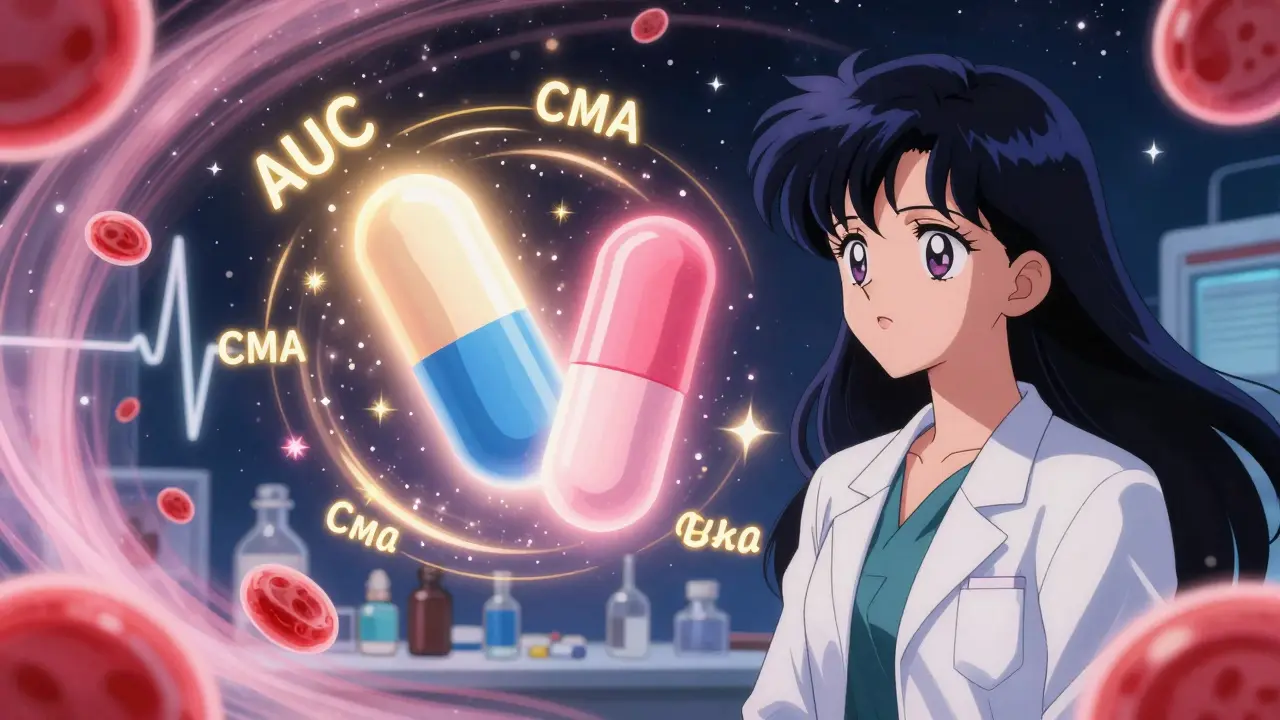
When you pick up a prescription at the pharmacy, you might see two options: the familiar brand-name pill in its colorful packaging, or a cheaper generic version with a plain label. Many people wonder - is the generic just as good? The answer lies in something called bioequivalence testing. It’s not marketing. It’s science. And it’s what ensures that a generic drug works the same way as its brand-name counterpart - down to how your body absorbs and uses it.
What Bioequivalence Testing Actually Measures
Bioequivalence testing doesn’t ask whether a drug cures the same disease. That’s already proven by the brand-name version. Instead, it asks: Does the generic drug get into your bloodstream at the same rate and in the same amount as the brand? The answer is measured using two key numbers: AUC (area under the curve) and Cmax (maximum concentration).
AUC tells you how much of the drug your body absorbs over time - the total exposure. Cmax tells you how quickly it gets there. For a generic to pass, both numbers must fall within 80% to 125% of the brand-name drug’s values. That’s not a guess. It’s a strict, science-backed range approved by the FDA and other global regulators. If a generic drug hits that range, it’s considered bioequivalent - meaning your body treats it the same way.
These tests are done in healthy volunteers, usually 24 to 36 people. Each person takes both the brand and the generic, at different times, under controlled conditions - often fasting. Blood samples are taken every 15 to 30 minutes over 24 to 72 hours. Then the data is compared. If the results stay inside that 80-125% window, the drug gets approved.
Why This Matters More Than You Think
Most people assume generics are just cheaper copies. But they’re not. They’re exact copies in active ingredient, strength, and dosage form. The only differences allowed are in color, shape, flavor, or inactive ingredients - things that don’t affect how the drug works. These differences can sometimes cause minor side effects, like stomach upset from a different filler, but they don’t change the drug’s effectiveness.
Before bioequivalence testing became standard, patients often got inconsistent results with generics. Some didn’t work as well. Others caused unexpected side effects. That changed with the Hatch-Waxman Act of 1984. It created the Abbreviated New Drug Application (ANDA) pathway, which lets generic manufacturers skip expensive clinical trials - but only if they prove bioequivalence. That’s why today, over 90% of prescriptions in the U.S. are filled with generics.
And it’s not just about cost. In 2020 alone, generics saved the U.S. healthcare system $313 billion. That’s billions of dollars that didn’t go to drug companies - and stayed in patients’ pockets, insurance plans, and hospital budgets.
How the FDA Ensures Consistency
The FDA doesn’t just approve a generic and walk away. Every manufacturing facility - whether in the U.S., India, or China - gets inspected at least once every two years. The agency checks for Good Manufacturing Practices (GMP). That means the generic drug must be made with the same precision as the brand. The active ingredient must be pure. The dosage must be consistent. Every batch must meet the same standards.
The FDA’s Orange Book is the public record of all approved generics. It lists every generic drug that’s been tested and approved as therapeutically equivalent to its brand-name version. Each entry has a rating - like “AB” - which tells pharmacists and doctors the generic can be substituted without concern.
And the system works. A 2022 Consumer Reports survey of 1,200 people found that 87% saw no difference between their generic and brand-name drugs. Nine percent even said the generic worked better. Only 4% reported it was less effective - and most of those cases involved changes in inactive ingredients, not the active drug.

Where Bioequivalence Testing Has Limits
Not all drugs are created equal - and not all can be tested the same way. Bioequivalence testing works best for pills and liquids that are absorbed into the bloodstream. But what about inhalers, creams, or eye drops? For those, the drug doesn’t need to reach the bloodstream. It needs to work right where it’s applied.
For inhalers, the FDA now requires clinical endpoint studies - measuring how well the drug opens airways - instead of blood tests. For topical creams, they look at how much of the drug penetrates the skin. These are harder to standardize, and regulators are still refining the methods. That’s why some complex generics - like certain asthma inhalers or eczema creams - take longer to approve.
Dr. Jerry Avorn from Harvard Medical School points out that narrow therapeutic index drugs - like warfarin, lithium, or certain seizure medications - need extra care. A tiny difference in absorption can cause serious side effects. For these, the FDA sometimes tightens the bioequivalence range to 90-111% instead of 80-125%. Some countries even require additional clinical studies.
Myths vs. Reality
Despite all the science, myths still circulate. One common belief? “Generics take longer to kick in.” That’s false. If a generic passes bioequivalence testing, its Cmax is within the allowed range. It gets into your system just as fast.
Another myth? “Generics are weaker.” No. The active ingredient is identical. The dose is the same. The only thing different is the price - and the label.
A 2021 study in the Journal of Generic Medicines found that 32% of patients still believed generics were less effective. That’s not because the science is flawed. It’s because of fear, misinformation, or a single bad experience with a different filler. But when patients switch back and forth between brand and generic over time - as many do - they rarely notice any real difference.
What’s Next for Bioequivalence Testing
The future of bioequivalence is moving beyond blood tests. The FDA and EMA are exploring computer modeling - called physiologically based pharmacokinetic (PBPK) modeling - to predict how a drug behaves in the body. This could reduce the need for human trials for some complex drugs.
For example, if a generic manufacturer can show through modeling that their pill dissolves the same way as the brand under different stomach pH levels, they might not need to run a full human study. It’s faster, cheaper, and still scientifically valid.
Global standards are also aligning. The International Council for Harmonisation (ICH) has created shared guidelines so that a bioequivalence study approved in the U.S. is more likely to be accepted in Europe or Japan. That means more generics can reach patients faster - and at lower cost.
Bottom Line: Trust the Science
Bioequivalence testing isn’t perfect. But it’s the most reliable, widely accepted system we have. It’s not about saving money - it’s about saving lives by making essential medicines affordable. The FDA, EMA, and other agencies don’t approve generics lightly. They require proof - hard, measurable proof - that the drug works the same way in your body.
If your doctor prescribes a generic, or your pharmacist switches your brand to a generic, you can trust it. The science says so. The data says so. And millions of patients every day are living proof that it works.
Do generic drugs work as well as brand-name drugs?
Yes. Generic drugs are required to meet the same strict standards as brand-name drugs. Bioequivalence testing proves they deliver the same amount of active ingredient into your bloodstream at the same rate. The FDA and other global agencies confirm that generics are therapeutically equivalent for the vast majority of medications.
Why do generics look different from brand-name drugs?
By law, generics can’t look exactly like the brand-name version. That’s why they often have different colors, shapes, or markings. These differences are only in inactive ingredients - like fillers or dyes - which don’t affect how the drug works. The active ingredient, strength, and dosage form must be identical.
Are there any drugs where generics might not work as well?
For most drugs, generics work just as well. But for drugs with a narrow therapeutic index - such as warfarin, lithium, or certain epilepsy medications - even small differences in absorption can matter. In these cases, regulators may require tighter bioequivalence standards or additional testing. Always talk to your doctor if you’re switching one of these medications.
Why do some people say generics don’t work for them?
Some people report side effects like stomach upset or headaches after switching to a generic. This is usually due to changes in inactive ingredients - not the active drug. For example, a different filler might cause sensitivity in rare cases. But these are not signs of reduced effectiveness. If you experience this, talk to your pharmacist or doctor - they can help you switch to a different generic brand or stay on the brand if needed.
How long does it take for a generic drug to be approved?
The FDA’s average review time for a generic drug application (ANDA) is 10 to 12 months. Bioequivalence studies - the most time-consuming part - typically take 6 to 8 months to complete and analyze. Once approved, the generic can be sold immediately. The process is faster than for brand-name drugs, which require years of clinical trials.
Is bioequivalence testing the same worldwide?
Most major regulators - including the FDA, EMA, and Health Canada - use the same 80-125% bioequivalence range for standard oral drugs. Some countries, like Japan, have minor variations. For complex products like inhalers or topical creams, requirements may differ slightly. But global harmonization through the ICH has made standards much more consistent than in the past.

Greg Quinn
December 29, 2025 AT 04:13It's wild how much trust we put in a number range-80% to 125%. Like, that’s a 45% swing. But somehow, it works. I think we’ve all just accepted that science is weirdly forgiving when it needs to be. And honestly? I’m fine with that. As long as my blood pressure meds don’t turn me into a zombie, I’m not digging deeper.
Manan Pandya
December 30, 2025 AT 14:30The bioequivalence framework is elegantly pragmatic. The 80–125% confidence interval for AUC and Cmax is statistically robust, derived from log-transformed data under a two-sequence, two-period crossover design. This ensures that pharmacokinetic variability is accounted for without compromising therapeutic equivalence. The FDA’s adherence to ICH guidelines reinforces global interoperability of regulatory decisions.
Aliza Efraimov
January 1, 2026 AT 00:33I switched my antidepressant to generic last year and had a panic attack because I thought it wasn’t working. Turns out, my brain was just freaking out because the pill was a different color. I cried. I Googled. I almost called my doctor. Then I read this. And now I’m fine. Like, really fine. Thank you for explaining it like I’m not a science dropout. I feel seen.
Nisha Marwaha
January 2, 2026 AT 07:31The ANDA pathway represents a paradigmatic shift in pharmaceutical regulation-de-coupling therapeutic efficacy validation from preclinical and Phase III clinical trials by leveraging pharmacokinetic surrogates. Bioequivalence, as operationalized via the 80–125% confidence interval for Cmax and AUC0–t, is grounded in the principle of therapeutic equivalence under the assumption of linear pharmacokinetics. For narrow therapeutic index drugs, the tightened interval (90–111%) mitigates risk of subtherapeutic or toxic exposure.
Paige Shipe
January 3, 2026 AT 21:08Let me just say this: if you're taking generics, you're basically gambling with your life. The FDA is corrupt. They approve these things because they're paid off by Big Pharma. I read a blog once that said generics are made in factories with rats running through the halls. I don't trust it. I pay extra. I sleep better.
Tamar Dunlop
January 5, 2026 AT 11:09It is, without a doubt, a matter of profound societal importance that pharmaceutical accessibility is balanced against scientific rigour. The bioequivalence paradigm, while empirically sound, must be continually evaluated in light of global health equity. In nations where access to healthcare is not universal, the availability of affordable generics is not merely a fiscal consideration-it is a moral imperative.
David Chase
January 6, 2026 AT 15:11GENERIC DRUGS ARE A SCAM!! 🤬🇺🇸 We pay for American-made brand drugs because we deserve quality! India? China? No way! My grandfather fought in WWII so we could have REAL medicine, not some cheap knockoff made by people who don’t even know what a pill is! 😡💊 #AmericaFirst #BuyAmerican #NoMoreGenericTrash
Emma Duquemin
January 8, 2026 AT 03:58Okay, but have you ever seen a generic pill that looks like a tiny rainbow unicorn? I did. Took it for my anxiety. Felt like I was taking magic fairy dust. It worked. I cried. Then I laughed. Then I bought three more bottles. The system is weird, wild, and honestly? Kinda beautiful. Science with soul. Who knew?
Kevin Lopez
January 8, 2026 AT 11:0880–125% is a joke. If you’re not 100% identical, you’re not equivalent. End of story. The FDA’s standards are lazy. And don’t get me started on the “inactive ingredients” excuse. That’s just corporate-speak for ‘we don’t care.’
Duncan Careless
January 9, 2026 AT 01:57Interesting piece. I’ve always wondered about the testing process. I work in a pharmacy in Scotland and see patients switch daily. Most never notice. But I’ve had a few say their ‘head feels funny’ after switching-usually due to lactose or dye. Always check the fillers. Simple as that.
Samar Khan
January 10, 2026 AT 18:44Generics are why my mom died. 💔 She took the cheap one. It didn’t work. They said it was bioequivalent. Liar. Liar. Pants on fire. 🤡
Russell Thomas
January 12, 2026 AT 13:04Oh wow, so you’re telling me the government spent billions to prove that a pill that looks different costs less but does the same thing? Groundbreaking. Next you’ll tell me water is wet. I’m so glad I wasted my morning reading this. 😴
Joe Kwon
January 12, 2026 AT 23:04Really appreciate this breakdown. PBPK modeling is the future-especially for complex formulations. I’ve been working on a project simulating gastric pH effects on extended-release metformin. It’s wild how accurate the models get now. Could cut human trials by 70% for some drugs. Science is evolving. Good to see regulators keeping up.
Nicole K.
January 14, 2026 AT 11:42If you're taking generics, you're just being cheap. People who do that don't care about their health. I wouldn't trust my life to something that doesn't have a fancy name on it. It's just wrong.
Fabian Riewe
January 16, 2026 AT 04:48My dad’s been on generic warfarin for 12 years. No issues. His INR’s stable. He’s 84 and still tending his garden. I used to worry too. Then I read the FDA’s Orange Book. Saw the AB rating. Stopped stressing. Sometimes the simplest answer is the right one: if it’s approved, it works. Trust the process. 🌱