
You skip a dose because the copay is too high. It happens more often than you might think. In fact, nearly one-third of adults in the U.S. admit to cutting corners on their prescriptions-skipping doses, splitting pills, or not filling them at all-just to save money. This isn't just about being cheap; it's about survival in a system where brand-name drugs can cost hundreds of dollars out of pocket. But here is the good news: switching to generic medications doesn't just save you cash at the pharmacy counter. It fundamentally changes how likely you are to stick to your treatment plan, which in turn saves the healthcare system billions.
Why do lower generic prices improve patient adherence?
Lower prices reduce the financial barrier to entry. When a patient faces a $10 copay instead of $100, they are significantly less likely to skip doses or delay filling prescriptions. Studies show a direct 'dose-response' relationship where every $10 increase in out-of-pocket cost leads to a 2-4% drop in adherence rates.
The Direct Link Between Price and Pill-Popping
Let’s get straight to the point: cost matters. A lot. Research consistently shows that when patients have to pay more for their medicine, they take less of it. A systematic review published in the Journal of Managed Care & Specialty Pharmacy (JMCP) in 2022 analyzed 160 different studies. The result? Higher cost-sharing was consistently linked to lower adherence. It’s a simple equation: as your wallet hurts more, your health outcomes get worse.
This isn't just a vague trend. It follows a predictable pattern known as a 'dose-response' relationship. For every $10 increase in what you pay out of pocket, your likelihood of sticking to your prescription drops by 2% to 4%. Imagine you are taking a GLP-1 receptor agonist for diabetes. If your copay goes up by just $10, your chance of staying adherent drops by 3.7%. That small dip in consistency leads to a 5.2% spike in emergency room visits. You aren't just paying more for the pill; you're paying more for the crisis that follows when you don't take it.
Consider the experience of u/HeartHealthJourney on Reddit, who shared a real-world example from March 2024. After their cardiologist switched them from brand-name Crestor with a $75 copay to generic rosuvastatin with a $5 copay, they went from missing three or four doses a week to perfect adherence for over a year. That single switch didn't just save $70 a month; it stabilized their heart health. This story plays out in pharmacies across the country every day.
Are Generics Really Just as Good?
If price is the main driver of adherence, generics win hands down. They cost 80% to 85% less than brand-name equivalents. But does that discount come with a catch? Do you get inferior medicine? The short answer is no. The Food and Drug Administration (FDA) requires generic drugs to contain the exact same active ingredient, strength, dosage form, and route of administration as the brand-name drug. They must also demonstrate bioequivalence, meaning they work in your body within an 80-125% range of the brand-name profile.
In practical terms, this means your body processes the generic drug almost identically to the brand. Despite this equivalence, some patients still hesitate. Why? Often, it’s confusion or old habits. However, data from U.S. Pharmacist (2021) shows that when priced comparably, adherence rates for generics are actually 15% to 20% higher than for brand names. People trust the routine of a low-cost, reliable option. The FDA’s 'It's Okay to Use Generics' campaign has helped chip away at these misconceptions, but education remains key.
| Feature | Brand-Name Drugs | Generic Drugs |
|---|---|---|
| Average Cost Difference | Baseline | 80-85% cheaper |
| Active Ingredient | Original formula | Identical |
| Bioequivalence | N/A | 80-125% of brand profile |
| Adherence Rates | Lower (when expensive) | 15-20% higher |
| Market Share | ~10% of prescriptions | ~90% of prescriptions |

The Hidden Cost of Non-Adherence
We tend to focus on the price tag at the pharmacy, but that’s only part of the story. The real economic damage happens when people stop taking their meds. Medication non-adherence accounts for up to 50% of all treatment failures. That means half the time a therapy doesn’t work, it’s not because the drug failed-it’s because the patient didn’t take it correctly.
The human toll is staggering. Non-adherence contributes to over 100,000 preventable deaths annually in the United States. Economically, it generates between $100 billion and $300 billion in preventable healthcare costs every year. These aren't abstract numbers. They represent hospital stays, emergency surgeries, and long-term disability care that could have been avoided with a simple, affordable pill.
Take cardiovascular health, for instance. Dr. D. Hershman from Columbia University studied women with early-stage breast cancer taking aromatase inhibitors. Those on brand-name medications had a discontinuation rate of 22.3%, compared to 17.8% for those on generics. Their adherence rates were also lower (68.4% vs. 73.1%). Higher copays directly correlated with stopping the medication. In chronic conditions like hypertension or diabetes, stopping meds leads to strokes, amputations, and kidney failure. The $50 saved on a generic statin is tiny compared to the $50,000 bill for a heart attack recovery.
How Insurance Tiers Shape Your Choices
Your insurance plan likely uses a tiered formulary structure. This system groups drugs into categories based on cost. Tier 1 usually includes preferred generics with low copays (often around $10). Tier 2 or 3 might include non-preferred brands with copays jumping to $100 or more. This structure creates a massive psychological and financial barrier.
When researchers looked at Medicare Part D beneficiaries, they found that moving brand-name statins like atorvastatin from a second-tier to a first-tier status resulted in a statistically significant 5.9% increase in the Proportion of Days Covered (PDC). Simply put, making the drug cheaper made people take it more consistently. The Inflation Reduction Act of 2022 has started to reshape this landscape by capping insulin costs at $35/month and eliminating catastrophic coverage gaps by 2025. These policy shifts acknowledge what we’ve known for years: if you want better health outcomes, you need to remove the price shock.
Tools That Bridge the Gap
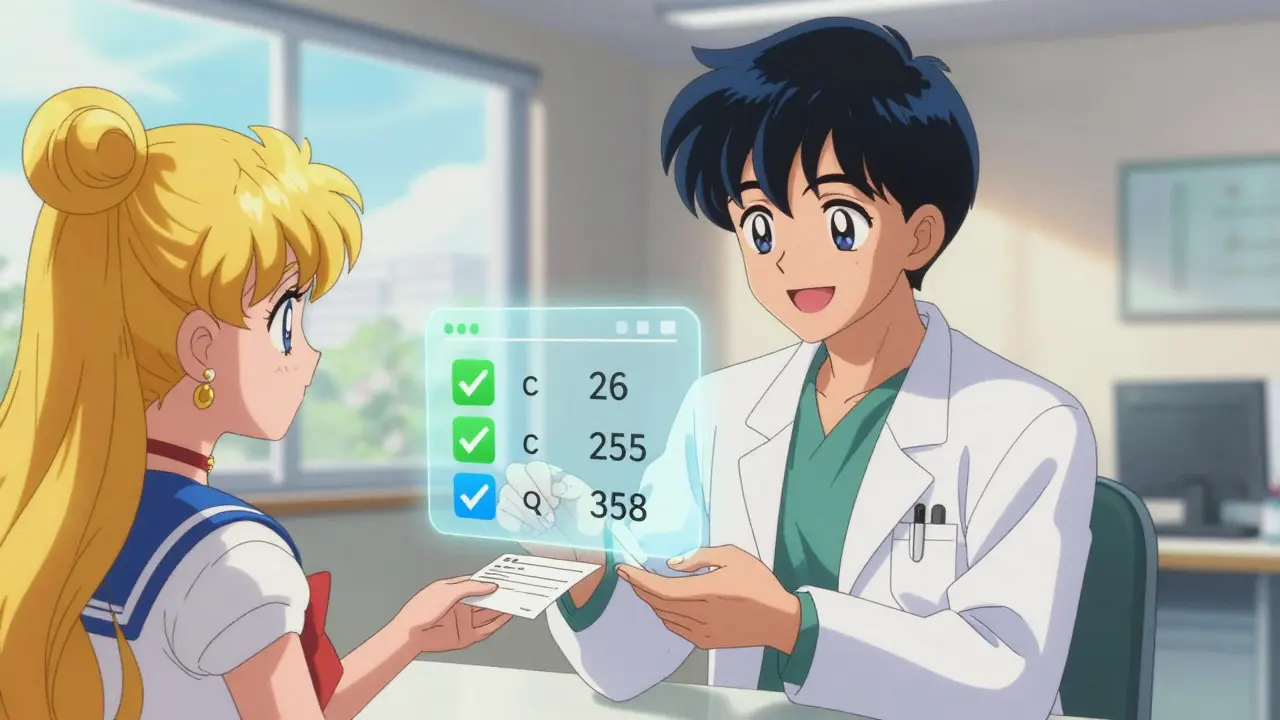
Knowing the price upfront is half the battle. Real-time benefit tools (RTBTs) are changing how doctors prescribe. These tools integrate with electronic health records (EHRs) to show the exact out-of-pocket cost for a patient at the moment of prescribing. Pilot programs using systems like Magellan Healthcare’s inforMED have shown a 12-15% improvement in adherence. Why? Because the doctor can immediately suggest a cheaper generic alternative if the brand name is too expensive for that specific patient.
However, these tools require coordination. Setting them up takes 6-8 weeks and staff training. Patients also need to understand what they’re looking at. Apps like GoodRx help by showing real-time pricing across local pharmacies, mitigating the complexity of insurance formularies. The goal is transparency. When a patient knows exactly what they will pay before leaving the doctor’s office, they are far less likely to be surprised-and far more likely to fill the script.
The Bigger Picture: Global Context and Future Trends
It’s worth noting that Americans pay significantly more for medications than residents of other developed nations. According to the Commonwealth Fund (2023), U.S. citizens pay 256% more for brand-name drugs than people in countries like Japan, the UK, Germany, and Canada. While generics help mitigate this disparity, the overall market remains skewed. From January 2022 to January 2023, prices for over 4,200 drug products increased, with nearly half exceeding inflation rates.
Despite this, the generic market is a powerhouse. It represents 90% of all prescriptions filled in the U.S. but only 23% of total spending. From 2009 to 2019, generics generated $643 billion in healthcare savings. Looking ahead, the FDA’s 2023 Generic Drug User Fee Amendments (GDUFA III) commit $1.1 billion to streamline approvals, aiming to add 1,500+ new generic medications by 2027. This influx of competition should keep that 80-85% savings differential intact.
Future research is focusing on 'value-based insurance design,' where copays align with the clinical value of the medication rather than just its cost. Early pilots show an 18.3% adherence improvement for high-value drugs in diabetes and cardiovascular care. The message is clear: lowering barriers to entry through generic substitution and smart pricing structures isn't just good economics-it’s good medicine.
What is cost-related medication nonadherence (CRN)?
CRN occurs when patients decide not to fill a prescription, skip doses, take less medicine, delay filling, or use someone else's medication to save money. A 2023 JAMA Network Open survey found that 32.7% of adults reported engaging in CRN behaviors.
Do generic drugs have side effects?
Generic drugs have the same active ingredients as brand-name drugs, so they have the same potential side effects. Differences in inactive ingredients (fillers) are rare causes of issues, but therapeutic outcomes are clinically equivalent.
How much can I save by switching to generics?
On average, generic drugs cost 80% to 85% less than brand-name equivalents. For many common conditions, this can mean saving tens or even hundreds of dollars per month depending on your insurance tier.
Can my doctor force me to take a generic?
Doctors cannot force you, but insurance plans often require prior authorization for brand-name drugs if a generic is available. Most doctors prefer generics due to lower patient costs and proven efficacy, but you can discuss alternatives if you have concerns.
What is the 'dose-response' relationship in medication costs?
This term describes the direct correlation between cost and adherence: as out-of-pocket costs increase, adherence rates decrease proportionally. Specifically, every $10 increase in cost can lead to a 2-4% drop in adherence.
