
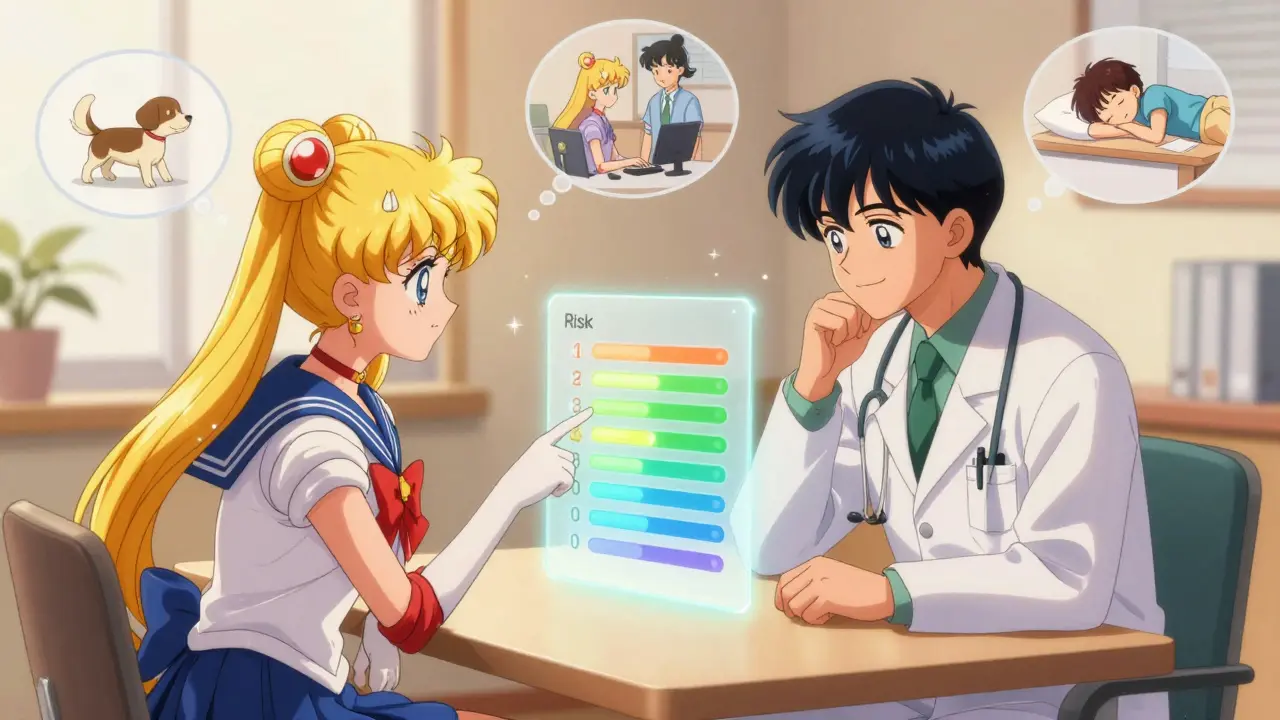
Side Effect Trade-Off Calculator
Calculate Your Personal Treatment Trade-Offs
This tool shows you the actual numbers behind treatment benefits and side effects, not just percentages. Knowing "15 out of 100 people" is more powerful than "15%" for making decisions that match your life.
What this means: When you understand side effects as absolute numbers (like "15 out of 100"), you're 37% more likely to understand the risk. The best treatment isn't the one with the fewest side effects—it's the one you're willing to live with.
When your doctor says, "This pill might make you nauseous," and you nod along, but inside you’re thinking, "But what if it makes me dizzy at work? Or worse-what if I can’t sleep for weeks?"-you’re not alone. Most patients don’t know how to ask the right questions about side effects. And too often, doctors don’t know how to ask them the right questions either. That’s where shared decision-making scripts come in. Not as rigid scripts to read from, but as real, human tools to help you and your doctor weigh what matters most: the benefits of treatment versus the real-life costs of side effects.
Why Side Effect Trade-Offs Are Hard to Talk About
It’s not that doctors are hiding information. It’s that side effects are messy. One person’s "minor" side effect is another person’s deal-breaker. Nausea might be tolerable for a student but disastrous for a truck driver. Fatigue might be a small price to pay for someone with chronic pain, but a nightmare for a new parent. Yet, most conversations still use vague terms like "rare" or "common." That’s not helpful. If a drug causes nausea in 15 out of 100 people, that’s not "rare." That’s 1 in 7. That’s someone you know. Research from the Agency for Healthcare Research and Quality (AHRQ) shows that when patients hear side effects described as absolute numbers-"15% chance of nausea" instead of "some people get nauseous"-they understand the risk 37% better. And when they understand, they’re more likely to stick with the treatment. But understanding doesn’t happen by accident. It happens when the conversation is structured.The SHARE Approach: A Step-by-Step Framework
The SHARE Approach isn’t a script you memorize. It’s a rhythm. Five steps that turn a rushed check-in into a real partnership:- Seek opportunities to include you in the decision. A good clinician won’t say, "Here’s your prescription." They’ll say, "We have a few options here. Which one feels more aligned with how you want to feel day-to-day?"
- Help you explore options. This means comparing not just drugs, but outcomes. "Option A reduces your risk of stroke by 20%, but 1 in 5 people get headaches. Option B has a slightly lower stroke benefit, but only 1 in 20 get stomach issues. Which trade-off feels better to you?"
- Assess your values. This is the most important step. Not what the doctor thinks is best-but what matters to you. "What side effect would make you stop taking this?" is a game-changer. Most patients haven’t been asked that before.
- Reach a decision together. No more "I’ll take whatever you think is best." Now it’s "Okay, so we’re going with Option B because the stomach issues are less likely, and you’re okay with the small chance of mild dizziness?"
- Evaluate later. Did the side effects hit the way you expected? Did you need to adjust? This isn’t a one-time talk. It’s a conversation that continues.
The Three-Talk Model: When the Stakes Are Higher
For treatments with serious risks-like chemotherapy, blood thinners, or long-term antidepressants-the Three-Talk Model adds structure to the urgency:- Option Talk: "Here are your choices. This one has a 3% risk of major bleeding. That means 97 out of 100 people won’t have it. This one has a 1% risk but requires daily blood tests. Which risk are you more comfortable managing?"
- Decision Talk: "What’s your biggest fear about this treatment? What’s your biggest hope?" This isn’t about medical facts. It’s about your life. Can you still hike? Can you still work nights? Can you sleep through the night?
- Implementation Talk: "How will we know if this is working? What signs should you watch for? Who do you call if it gets worse?"
What Patients Actually Say (And What They Wish Doctors Would Ask)
On Reddit’s r/medicine, a patient wrote: "My doctor told me statins might cause muscle pain. I didn’t say anything because I didn’t think it mattered. Later, I stopped taking them because I couldn’t climb stairs. I didn’t know I could have asked for a different drug." A 2022 survey by the Informed Medical Decisions Foundation found that 84% of patients felt more confident in their choice when their doctor used structured questions. The most powerful question? "Which side effect would be a deal-breaker for you?" That’s not a question doctors are trained to ask. But when they do, the results change. At Scripps Health, patients who were asked this question were 41% more satisfied with their care. And those who used visual risk charts-color-coded bars showing side effect probabilities-were more likely to stick with their treatment.
Why This Works Better Than Just "Informed Consent"
Traditional informed consent is a form you sign. Shared decision-making is a conversation you remember. One is legal protection. The other is trust. A 2021 JAMA Internal Medicine study found that patients who had structured SDM conversations about chemotherapy were 29% less likely to quit treatment because of unexpected side effects. Why? Because they weren’t surprised. They’d already talked about what was possible-and what they could live with. It’s not just about avoiding side effects. It’s about avoiding regret. The Massachusetts General Hospital Health Decision Sciences Center found that 42% of patients who regretted their medication choices did so because they didn’t realize how much the side effects would interfere with daily life. That’s not a medical failure. That’s a communication failure.What Gets in the Way
Time. That’s the biggest barrier. A 2022 time-motion study at Scripps Health found that full SDM conversations add about 7.3 minutes to a visit. That’s a lot when doctors are seeing 25 patients a day. But here’s the twist: those extra minutes save time later. Patients who have clear, shared decisions make 22% fewer follow-up visits for side effect complaints. They’re less likely to stop and restart meds. They’re less likely to end up in the ER. Another problem? Scripts used poorly. If a doctor reads from a checklist like a robot, patients feel dismissed. A 2022 Journal of Patient Experience study found that when scripts are applied rigidly, patient satisfaction drops by 19%. The trick isn’t memorizing lines-it’s using the structure to listen better.What’s Changing Right Now
In 2023, Medicare Advantage plans were required to document shared decision-making for high-risk medications. That’s driving adoption. Hospitals using Epic Systems now have built-in SDM prompts in their electronic records. These aren’t pop-ups-they’re guided questions that appear when a doctor selects a high-risk drug. The American Medical Association also created new billing codes (96170-96171) that pay doctors $45-$65 for documented SDM conversations. That’s real incentive. And it’s working. By 2026, AHRQ predicts 92% of major U.S. health systems will use some form of shared decision-making for side effect trade-offs. This isn’t a trend. It’s the new standard.
What You Can Do Today
You don’t need a fancy system. You don’t need to wait for your doctor to lead. Here’s what you can do before your next appointment:- Write down: "What’s the one side effect I’m most afraid of?"
- Ask: "If you were me, which option would you choose-and why?"
- Ask: "What would make you stop this medication?"
- Ask: "Can you show me the numbers? How many people out of 100 get this side effect?"
- Bring a list of your daily routines: work hours, childcare, exercise, hobbies. Side effects aren’t just about your body-they’re about your life.
Real Examples That Work
A 62-year-old man with high cholesterol was prescribed a statin. He was told, "Some people get muscle pain." He didn’t say anything. He stopped taking it after two weeks because he couldn’t walk his dog. Later, he returned. This time, his doctor asked: "What’s your favorite thing to do that you’d hate to give up?" He said, "Walk with my grandkids." They switched to a lower-dose statin with fewer muscle side effects-and added a walking plan. He’s been on it for a year. A woman with atrial fibrillation was offered a blood thinner. She was terrified of bleeding. Her doctor showed her a chart: "1 in 50 people have a major bleed each year. But without this, your stroke risk is 1 in 10." She chose the drug. She now carries a medical alert card. She’s hiking again. These aren’t miracles. They’re conversations.What if my doctor doesn’t know about shared decision-making?
You can still lead the conversation. Bring printed materials from the Agency for Healthcare Research and Quality (AHRQ) website. Ask, "Can we use the SHARE Approach for this decision?" Many doctors are open to it-they just haven’t been trained to use it routinely. Your asking is part of the solution.
Are side effect trade-offs only for chronic conditions?
No. They’re most useful for long-term treatments-like statins, antidepressants, or blood thinners-where side effects build up over time. But even for short-term meds, like antibiotics or painkillers, asking, "What’s the most likely side effect?" helps you prepare. The goal isn’t to avoid all risk-it’s to make sure the risk matches your life.
Can I use these scripts for mental health medications?
Absolutely. In fact, they’re especially important here. Antidepressants can cause weight gain, sexual side effects, or emotional numbness. These aren’t "minor"-they’re life-altering. Asking, "Which side effect would make you stop this?" helps both you and your doctor find the right fit. Studies show patients on psychiatric meds who use SDM are 35% more likely to stay on treatment.
Do I need to use a decision aid or app?
Not necessarily. Many patients find simple charts or even a piece of paper with numbers helpful. But if you want tools, the Informed Medical Decisions Foundation offers free, evidence-based decision aids for common conditions. Look for ones that use absolute risk numbers-not percentages like "50% reduction." Those are misleading.
What if I change my mind after deciding?
That’s normal. Shared decision-making isn’t a one-time contract. It’s an ongoing dialogue. If side effects hit harder than expected, or if your life changes-say, you start a new job or have a baby-go back to your doctor. Say, "I thought I could handle this, but I was wrong. Can we adjust?" That’s not failure. That’s good care.

Doreen Pachificus
January 3, 2026 AT 12:57So many doctors just hand out scripts like they’re vending machine snacks. I once took a pill that made me feel like a zombie for six weeks and never thought to ask, 'What’s the real chance of this?'
Cassie Tynan
January 3, 2026 AT 21:15Oh wow, another ‘shared decision-making’ buzzword. Let me guess-the next thing they’ll sell us is a $200 app that asks, ‘Do you want to live or just not die?’
Vicki Yuan
January 5, 2026 AT 03:17Actually, this is one of the most important things I’ve read all year. The question ‘Which side effect would be a deal-breaker for you?’ changed how I talked to my psychiatrist. I told her I couldn’t handle weight gain or sexual side effects-and she switched me to something that actually worked. No more ‘you’ll be fine.’
Uzoamaka Nwankpa
January 5, 2026 AT 03:30I’ve been told my anxiety meds might make me sleepy. I didn’t say anything because I didn’t want to be ‘difficult.’ Now I’m unemployed because I can’t stay awake at my desk. No one asked me what my life looks like. Just gave me the pill and walked away.
Oluwapelumi Yakubu
January 5, 2026 AT 12:12Let me drop some truth bombs, fam. The system doesn’t want you to understand risk-it wants you to swallow the pill and shut up. Numbers? Charts? Nah. They’d rather you trust the white coat like it’s a sacred scroll. But you? You’re not a lab rat. You’re a human with a job, a kid, a dog, and a life that doesn’t fit in a 7-minute slot. Ask the damn question: ‘What’s the one thing that would make me quit?’ And if they blink? Walk out. Find someone who sees you.
Dee Humprey
January 7, 2026 AT 06:30This is gold. I used the SHARE approach with my cardiologist last month. I wrote down: ‘I can’t miss my daughter’s soccer games because I’m too dizzy.’ He didn’t even blink. We switched meds. I’m back on the sidelines now. You don’t need fancy tools-just courage and a pen.
Vikram Sujay
January 8, 2026 AT 21:58The structural integrity of patient-clinician epistemic exchange has been systematically eroded by institutional time constraints and the commodification of care. The SHARE framework, when applied with ontological humility, restores agency not as a procedural formality but as an existential act of co-constituted meaning-making. One must not mistake the instrument for the intention: the goal is not efficiency, but fidelity to lived experience. The 7.3-minute increment is not a burden-it is the sacred interval wherein the patient ceases to be a case and becomes a subject. The medical gaze, untempered by dialogue, is merely surveillance dressed in white.
Jack Wernet
January 10, 2026 AT 19:10As someone who’s worked in healthcare across three continents, I’ve seen this work-and I’ve seen it fail. The difference? It’s not the script. It’s the silence after the question. When the doctor waits. When they look you in the eye and don’t rush to fill the space. That’s when the real decision happens. I’ve watched patients cry when asked, ‘What do you want your life to look like?’ They hadn’t been allowed to imagine it before.
Charlotte N
January 11, 2026 AT 03:15So true… I asked my doctor for the numbers and he looked at me like I asked for a moon landing… then he pulled up a chart… I cried… I didn’t know 1 in 7 meant someone I know… I thought ‘rare’ meant like… lightning… not my neighbor… I’ve been on this med for 3 years and never asked… I’m so sorry I didn’t speak up sooner…