
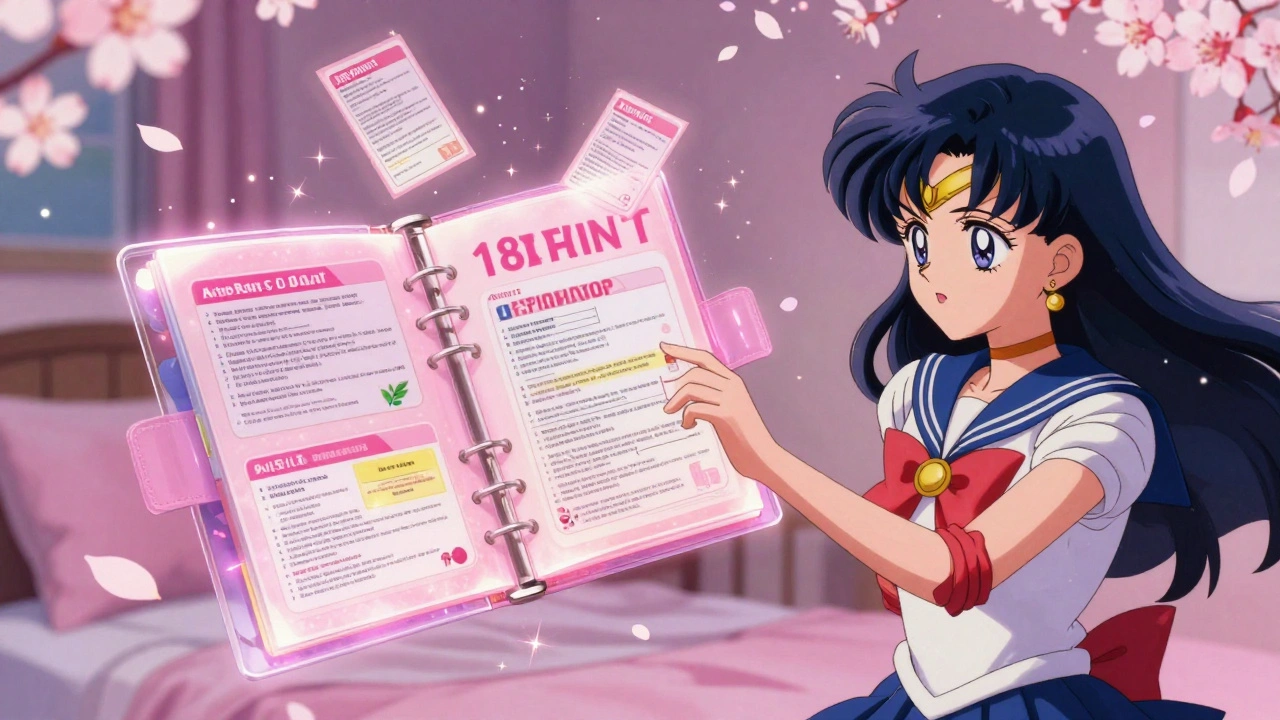
Keeping your prescription labels and medication leaflets isn’t just good housekeeping-it’s a life-saving habit. Every pill bottle you throw away without saving the label could cost you time, money, or even your health down the road. Imagine showing up at the ER after a fall, confused and in pain, and not being able to tell the doctors what meds you’ve been taking. That’s not hypothetical. It happens every day. And the fix? Simple: organize your prescription paperwork before you need it.
Why You Should Keep Prescription Labels and Leaflets
Prescription labels aren’t just receipts. They contain your name, the exact drug name, dosage, how often to take it, the prescriber’s name, pharmacy contact info, and expiration date. The leaflet? That’s the full story-side effects, interactions with food or other drugs, what to do if you miss a dose, and warnings about pregnancy, alcohol, or driving. The FDA requires all prescription containers to include this info in 18-point bold font so it’s readable. But if you toss the bottle, you toss the record. The Institute of Medicine found that medication errors cause about 7,000 deaths in the U.S. each year. A big reason? Poor record-keeping. When you switch doctors, get hospitalized, or see a specialist, they need to know what you’re taking. Without your records, they guess. And guessing with meds can be deadly. A 2022 study in the Journal of General Internal Medicine showed that patients who kept organized medication records had 55% fewer adverse drug events. That’s not a small number. That’s the difference between going home and ending up in intensive care.What to Save: Labels and Leaflets
Don’t just save the label on the bottle. Save the entire leaflet that comes inside. These are often 8 to 12 pages long and include critical details like:- Drug interactions (e.g., “Do not take with grapefruit juice”)
- Storage instructions (some meds must be refrigerated)
- What to do in case of overdose
- Warnings for seniors, pregnant women, or people with kidney/liver issues
- Generic vs. brand name equivalents
Physical Storage: The Reliable Way
If you prefer paper, go old-school but smart. Use a three-ring binder with clear plastic sleeves. These protect your papers from spills, dust, and fading. Don’t just shove loose papers in a drawer. They’ll get crumpled, wet, or lost. Here’s how to set it up:- Get a 1.5-inch or 2-inch binder.
- Buy acid-free, pH-neutral plastic sleeves (available at office supply stores).
- Label each sleeve with the medication name.
- Insert the label and leaflet together.
- Organize alphabetically by drug name.
- Add color-coded tabs for categories: antibiotics, heart meds, diabetes, pain relief, etc.
Digital Storage: The Modern Alternative
If you’re comfortable with tech, digital is powerful. You can scan or photograph your labels and leaflets and store them securely. But not just anywhere. Your health data is sensitive. HIPAA rules apply-even if you’re storing it yourself. Use apps designed for this:- MyMedSchedule (v3.2.1)-encrypts your photos, tracks expiration dates, and sends reminders.
- Medisafe-lets you upload labels and syncs with pharmacy alerts.
- Apple Health (iOS)-can import prescriptions from pharmacies that support it.
Hybrid System: Best of Both Worlds
The smartest approach? Combine physical and digital. Keep your current prescriptions-everything you’re actively taking-in the binder. That way, if the power goes out, your phone dies, or you’re in a rush at the ER, you’ve got a physical copy you can hand to a nurse. Scan everything older than six months. Upload it to a secure app. Label the files clearly: “Lisinopril 10mg-Prescribed by Dr. Chen-03/2023.” This system gives you instant access now and long-term backup later. It’s what most pharmacists and geriatric specialists recommend.What Not to Do
Avoid these common mistakes:- Throwing out old bottles-you might need proof of dosage history. One patient paid $1,200 in unnecessary tests because they couldn’t prove they’d been on the same dose for 10 years.
- Keeping everything in random drawers-you’ll lose it. The 2023 Consumer Reports survey found 29% of people who tried paper filing gave up because it got messy.
- Using non-secure apps-free apps often sell your data. Don’t risk it.
- Waiting until you’re sick-set this up now. Don’t wait for a crisis.
How Much Space You’ll Need
If you take 28 prescriptions a year (average for someone on multiple meds), over 10 years you’ll have 280 sets of labels and leaflets. Each set takes about 0.012 linear feet of space in a binder. Total? About 1.2 feet of shelf space. That’s less than a shoebox. Compare that to the cost of a hospital stay caused by a medication error-often tens of thousands of dollars.
When to Update Your Records
Make it part of your routine:- When you pick up a new prescription, add it to your binder or app within 24 hours.
- Every three months, review for expired meds and remove them.
- Before every doctor’s visit, check that your list is current.
- After a hospital discharge, update your records with any new meds or dose changes.
Help Is Available
You don’t have to figure this out alone. The CDC’s Medication Safety Helpline (1-800-232-0233) answered over 14,000 questions about record-keeping in 2023. The Institute for Safe Medication Practices offers a free downloadable guide called Your Medication Record: A Patient’s Guide-downloaded nearly 38,000 times in 2023. Pharmacists are also a great resource. Ask them to print extra copies of your leaflets. Most will do it for free.What’s Coming Next
The future is moving fast. By 2026, the federal government plans to link patient-maintained records directly to electronic health systems. By 2028, Medicare Part D may require proof of medication tracking to qualify for benefits. The message is clear: keeping your prescription records isn’t optional anymore. It’s part of your health care.Should I keep prescription labels even if I don’t take the medicine anymore?
Yes. Even if you stopped a medication, keep the label and leaflet for at least a year. Your doctor may need to know you tried it before-especially if side effects occurred or it didn’t work. Some conditions, like high cholesterol or depression, can return years later. Having the record helps avoid repeating mistakes.
Can I just use my pharmacy’s app to store my records?
Most pharmacy apps only store your current prescriptions and refill history. They don’t keep old labels or full leaflets. If you switch pharmacies, you lose access. Don’t rely on them alone. Always download or print copies for your own records.
Is it safe to scan and store prescription labels digitally?
Yes-if you use a HIPAA-compliant app with encryption. Avoid storing them in email, Google Drive, or unsecured cloud folders. Prescription data is a top target for hackers. Use apps like MyMedSchedule or Medisafe that are designed for health records and offer two-factor authentication.
What if I can’t afford a binder or app?
You don’t need fancy tools. Use a manila folder and a shoebox. Print out your labels and leaflets from your pharmacy’s website (most offer this). Staple them together. Write the drug name on the outside. Keep it in a drawer away from moisture. The goal isn’t perfection-it’s consistency. Even a basic system is better than nothing.
Do I need to keep leaflets for over-the-counter drugs too?
Yes, especially if you take them regularly. OTC meds like ibuprofen, antacids, or sleep aids can interact with prescriptions. For example, taking too much ibuprofen with blood pressure meds can cause kidney damage. Save the box or print the leaflet from the manufacturer’s website. Your doctor needs to know everything you’re taking-prescription or not.

Ben Greening
December 9, 2025 AT 22:39While the advice here is sound, I’d add that many pharmacies now offer digital copies of leaflets via their patient portals. It’s worth checking if your pharmacy provides this service before scanning anything manually. Also, consider printing a one-page summary of your meds for your wallet-just the drug names, doses, and prescribers. It’s not perfect, but it’s better than nothing in an emergency.
Nikki Smellie
December 11, 2025 AT 04:21Let’s be honest-this whole system is a distraction from the real issue: Big Pharma and the FDA are forcing us to keep records because they don’t trust doctors to get it right. They know medications are dangerous, and they’re covering their backs. You think this binder is for YOU? No. It’s for their liability insurance. And don’t get me started on QR codes-they’re tracking your every move. Your health data is being sold to insurers, employers, even advertisers. If you’re not encrypting everything with a Faraday cage and a password written in blood, you’re already compromised.
Raj Rsvpraj
December 12, 2025 AT 01:01Ha! You Americans think a binder and a phone app are ‘solutions’? In India, we’ve been managing polypharmacy for decades with handwritten notebooks-passed down through generations. No apps. No cloud. Just ink, memory, and family vigilance. You call this ‘modern’? This is colonial thinking-importing Western tech to solve problems that indigenous systems solved centuries ago. And yet, you still die from medication errors? Pathetic. Your ‘system’ is a luxury. Ours is survival.
Aileen Ferris
December 12, 2025 AT 10:46idk why ppl make this so complicated… just keep the bottles in a shoebox. i did it for 5 yrs and never had an issue. also who even reads leaflets? if u need to know side effects u just google it. lol.
Rebecca Dong
December 14, 2025 AT 05:42OH MY GOD. I JUST REALIZED I THREW AWAY MY ANTIBIOTIC LABEL LAST WEEK. WHAT IF I HAD A REACTION? WHAT IF I HAD A HEART ATTACK AND THEY GAVE ME SOMETHING THAT KILLED ME BECAUSE I DIDN’T KNOW I WAS ALLERGIC TO IT?!?! I’M GOING TO CRY. I’M GOING TO BUY A BINDER TODAY. I’M GOING TO SCAN EVERYTHING. I’M GOING TO PUT A LOCK ON MY DRAWER. I’M GOING TO TELL EVERYONE I KNOW. THIS IS A TERRIFYING REALITY AND I’M SO GLAD THIS POST EXISTED.
Michelle Edwards
December 15, 2025 AT 17:43This is such a thoughtful, practical guide-and honestly, it’s the kind of thing that feels obvious until you realize you’ve never done it. If you’re reading this and thinking, ‘I’ll start tomorrow,’ just do it now. Pick up one bottle. Take a photo. Write the name on a sticky note. That’s it. You don’t need to be perfect. You just need to begin. Your future self is already thanking you.
Sarah Clifford
December 16, 2025 AT 00:17why do people care so much about leaflets? i mean, i just take the pills and hope for the best. also, who has time to alphabetize a binder? i just throw mine in a bag and pray. also, why is everyone so scared of meds? i’ve been on 8 different ones and i’m still standing. lol.
Neelam Kumari
December 17, 2025 AT 00:01You people are pathetic. You spend more time organizing paper than you do understanding your own body. You trust a binder over your doctor? A QR code over your instincts? You’ve been conditioned to believe that documentation is safety-but safety is awareness. And awareness? That’s not found in a plastic sleeve. It’s found in silence, in listening to your own body, in refusing to swallow pills like they’re candy. You’re not preparing for emergencies-you’re preparing for a system that wants you dependent.
Queenie Chan
December 17, 2025 AT 11:13I love how this post treats medication records like a zen garden-neat, orderly, serene. But what about the person who’s homeless? Or undocumented? Or whose pharmacy refuses to print extra leaflets? Or who can’t afford a binder? Or whose vision is failing and can’t read 18-point font? The ‘solution’ here is beautifully written, but it’s written for the privileged. What’s the plan for the rest of us? The real crisis isn’t disorganization-it’s access. And until we fix that, your binder is just a very expensive placebo.
Stephanie Maillet
December 18, 2025 AT 14:03There’s something deeply human about holding a piece of paper that carries your health history-ink on pulp, a tangible record of survival. But there’s also something sacred in the digital echo: a cloud-backed, encrypted archive that survives fire, flood, and forgetting. Perhaps the real wisdom isn’t in choosing one over the other, but in honoring both-the physical as memory, the digital as continuity. We are creatures of both soil and signal. Why must we reduce care to a binary? Why not let the binder rest on the shelf, and the app hum quietly in the background-both serving the same quiet truth: we are fragile, and we are trying.